

A FINE DARWIN LETTER, WITH GOOD SCIENTIFIC CONTENT AND THE ENVELOPE ADDRESSED IN DARWIN'S HAND


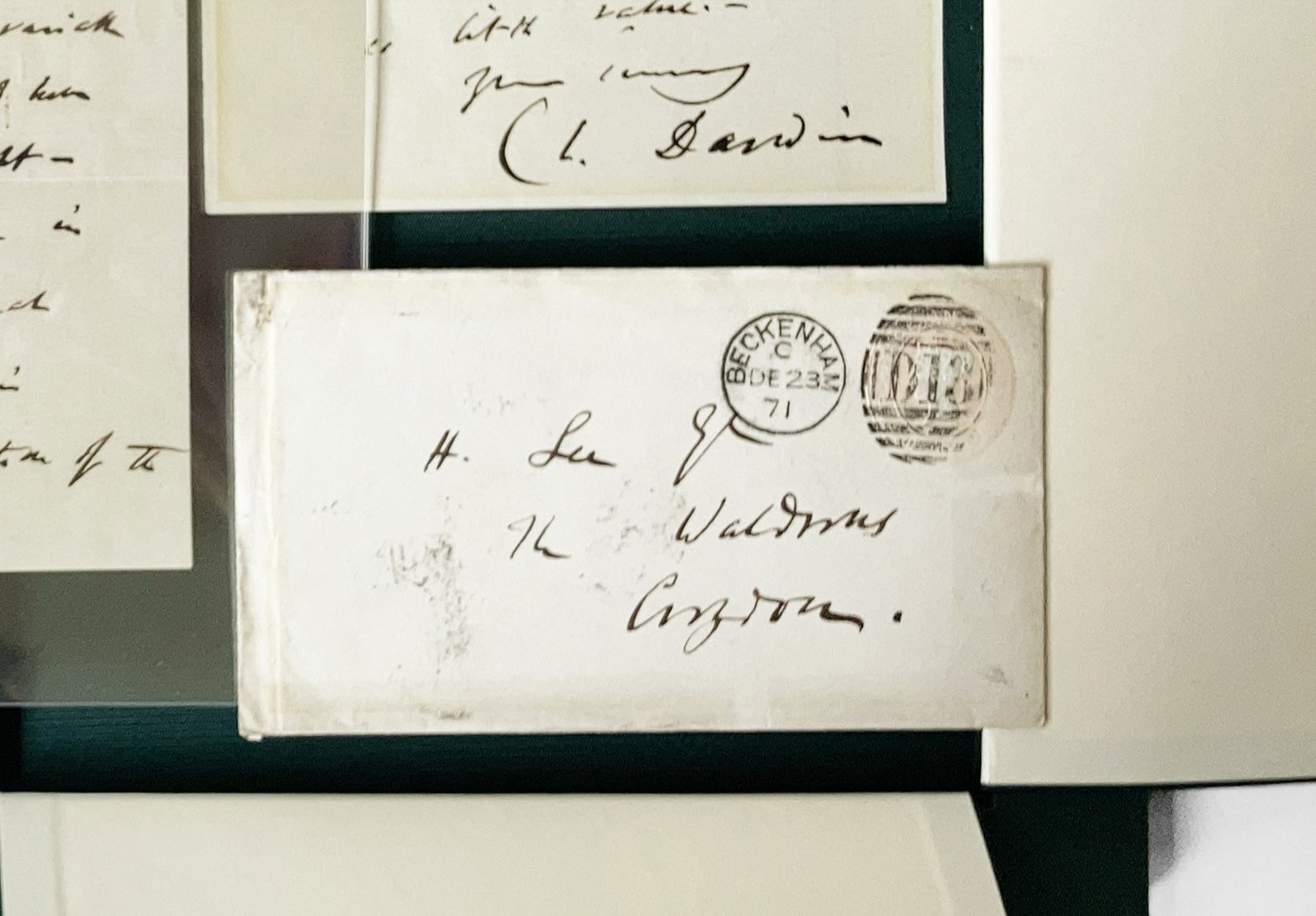
A FINE DARWIN LETTER, WITH GOOD SCIENTIFIC CONTENT AND THE ENVELOPE ADDRESSED IN DARWIN'S HAND
DARWIN, Charles (1809–1882)
Autograph Letter Signed (ALS), on barnacle classification, to Henry Lee, dated 23 December 1871, Down House, Kent
201 x 125mm; 2 leaves, retaining the original envelope, addressed in Darwin’s hand; stamped at Down and Beckenham on 23 December and at Croydon on 24 December. Loose leaves, housed in a custom-made drop-leaf cloth-bound folder with leather spine, gilt title, and inset photograph of Charles Darwin.
An attractive and revealing letter from Darwin, writing to the marine biologist Henry Lee, author of Sea Monsters Unmasked (1883), and referring to Darwin’s own original classificatory work in his famous barnacle monographs.
Over two leaves in his distinctive script, Darwin identifies two groups of barnacle specimens, telling Lee that both are Lepas antifera, the ‘pelagic gooseneck barnacle’ or ‘smooth gooseneck barnacle’. Darwin gives intricate details of the dissections he has conducted: “I have disarticulated the right-hand scutal valve in both & the umbonal teeth are plain in both”.
These are the diagnostic anatomical features that Darwin himself had identified in his Living Cirripedia (1851). Darwin goes on to discuss other minutiae of classification and offers to return the specimens by railway, adding “I have added a little spirits to the specimens, as corks leak.”
Darwin’s interest in this particular species is intimately connected with the development of his evolutionary thinking. While composing Living Cirripedia he had trained himself in micro-technique and, especially, fine dissection. This was not done simply to show off his classificatory skill: the Lepas genus had given Darwin a particular challenge, and in 1848 he sketched a small diagram and wrote the following note:
I have been much struck in Anatifera how the genus, (& I have no doubt universal, as evidenced by sub-genera) breaks up into little groups—hence those who use Diagnostic character have generally to refer to only 1 [or] 2 or 3 species—So again species break up into groups of varieties Genera again in same family are united into little groups—so throughout animal Kingdom—so children even in same Family.—It is universal law.
The sketch Darwin drew to illustrate this was in fact his third attempt to illustrate the ‘tree of life’, following his famous “I think…” sketch, and the less well known 1843 diagram that is accompanied by a note reading “a tree not good simile—endless piece of seaweed dividing”. The 1848 sketch, based on his researches into Lepas, is different again, showing clear grouping of species, what we would call polytomy.
Darwin’s barnacle work is famous – or rather infamous – for occupying the period building up to the composition of On the Origin of Species. In the years after Darwin’s death, an image of him as a somewhat dilletantish theorist was cultivated by, among others, his son Francis. This, together with an urge to dramatise the composition of the Origin, led to the idea that Darwin after the Beagle Voyage Darwin had delayed the development of his theory – perhaps because it would incur the wrath of the scientific and religious establishment. In this narrative, the barnacle work is merely a distraction from Darwin’s ‘proper’ research topic, namely evolution.
In fact the ‘gap’ between the Beagle and the Origin is a myth: Darwin did not ‘delay’, but instead worked carefully on his evolutionary theory, while prosecuting the barnacle classification. It is true that the latter was not a carefully planned activity, famously beginning with a single confusing specimen in 1846, winningly called by Darwin ‘Mr. Arthrobalanus’. But the barnacle work was important for Darwin for at least two reasons: first, it established him as a naturalist, rather than a geologist (as he had previous attempted to become), and, second, it allowed him to build up an exceptionally detailed knowledge of one single area of the natural world.
Darwin became a skilled microscopist, and turned himself from someone entirely reliant on others for close classificatory work into a master of these strange and complex creatures. He used the barnacles to explore questions of the evolution of the sexes, and also the nature of speciation itself. In the question of polytomy, explored through Lepas antifera, we see him confronting one of the central issues in evolutionary theory: does evolution itself occur more or less at random, or do the patterns of phyologenetic trees reveal some underlying ‘universal law’ of evolution itself?
Most of all, in this letter, we see Darwin as a skilled zoologist, fielding a query with care and confidence. Lee had first contacted Darwin in 1868, contributing information on sex ratios in trout, which were used in The Descent of Man. Late in 1871 Lee wrote to Darwin again, sending him information on two Lepas species, apparently in his possession. Darwin wrote back with information on the distribution of Lepas, leading to Lee’s request that Darwin examine the specimens personally. Darwin wrote back to say that he was suffering from ill health and overwork, and that he might not be able to undertake the task – but the evidence of this letter is that he went above and beyond, dissecting and reclassifying the barnacles that Lee had sent them (though perhaps not returning them, as the coda to his letter suggests).
Unusually, the letter retains the envelope, personally addressed by Darwin himself, postmarked at Down and Beckenham, 23 December 1871, received at Croydon a day later.
Provenance: Kenneth W. Rendell; Rick Watson.
Darwin Correspondence Project, Letter no. 8086a; The Correspondence of Charles Darwin Volume 19.
Near fine condition; envelope a little worn and marked.
Further reading:
J. David Archibald, Aristotle’s Ladder, Darwin’s Tree: The Evolution of Visual Metaphors for Biological Order (Columbia University Press, 2014), esp. p. 86
Kees van Putten, ‘Trees, Coral, and Seaweed: An Interpretation of Sketches Found in Darwin’s Papers’, Journal of the History of Biology 53 (2020) pp. 5–44, esp. p. 22–23
Rebecca Stott, Darwin and the Barnacle: The Story of One Tiny Creature and History's Most Spectacular Scientific Breakthrough (2003)