

FERMAT'S LAST THEOREM: SOLVED
FERMAT'S LAST THEOREM: SOLVED
WILES, Andrew (b.1952)
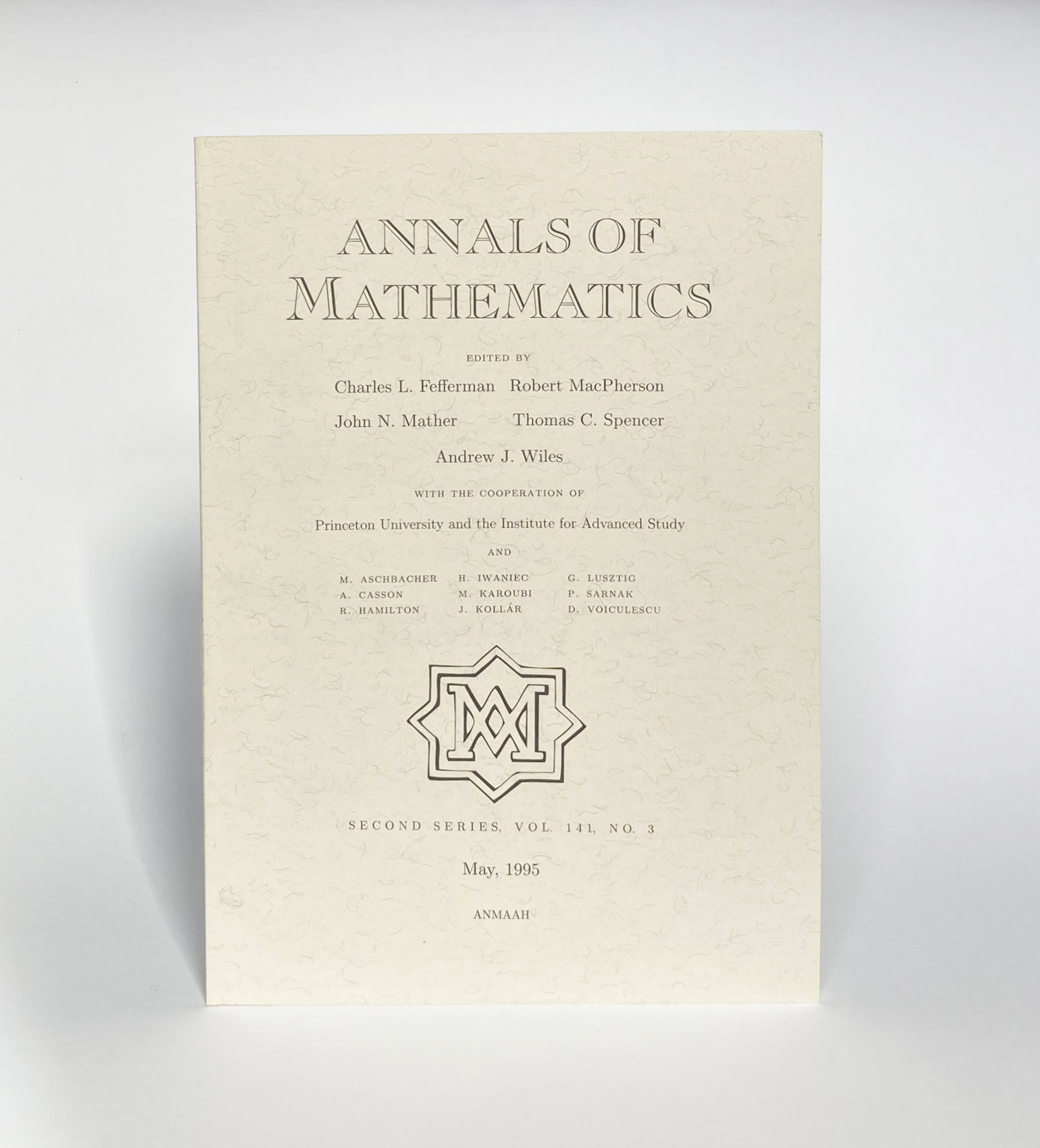
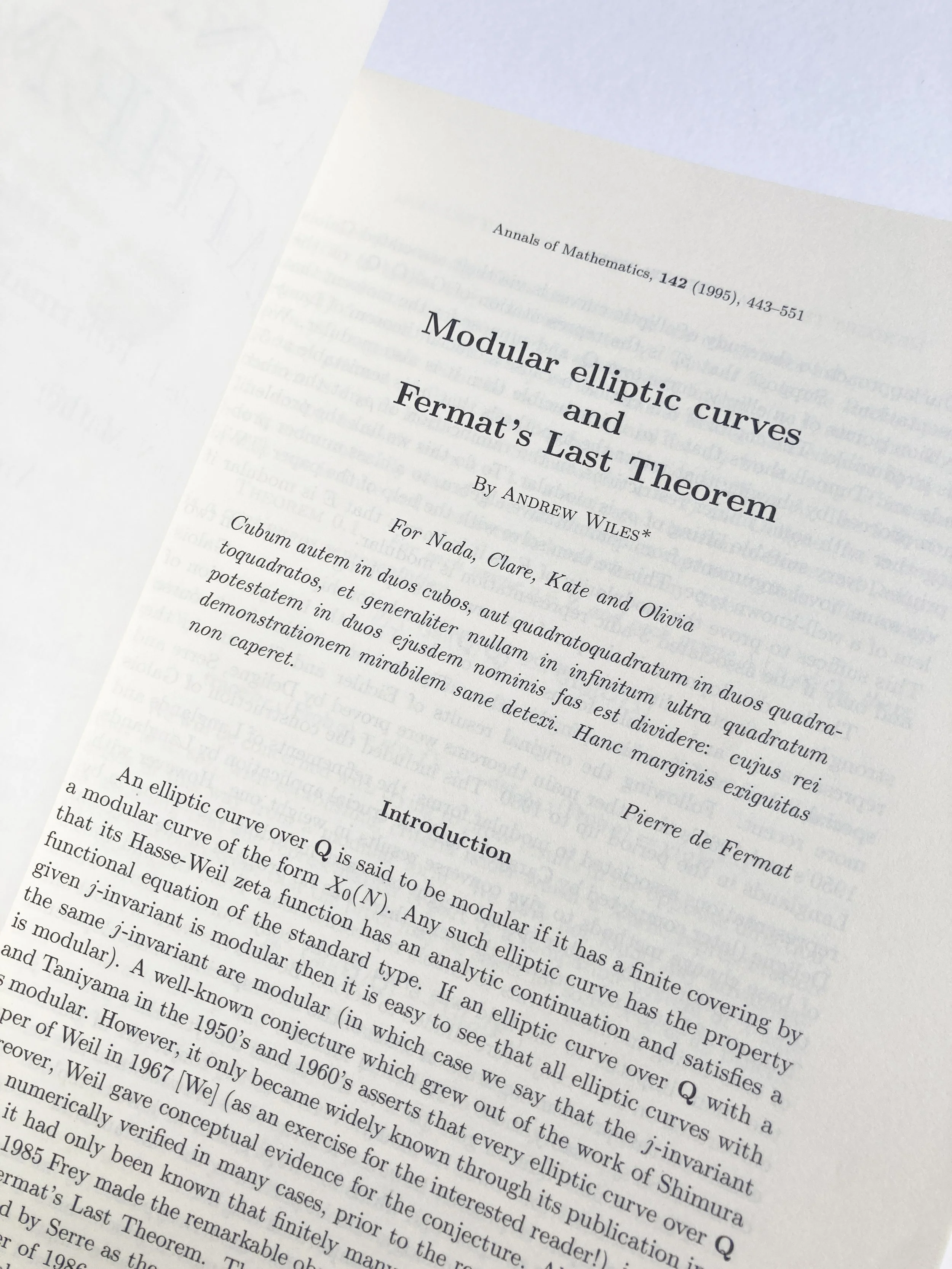
‘Modular elliptic curves and Fermat’s Last Theorem’
[in:] Annals of Mathematics, Vol. 141, No. 3
Princeton NJ: Princeton University Press, May 1995
Octavo (254 x 178mm); pp. 443–551
Single issue in original wraps; fine condition
One of the most romantic stories in the history of mathematics. On offer is the famous May 1995 issue of Annals of Mathematics, given over entirely to Wiles’ proof (with a supplementary paper by Wiles with Richard Taylor) of the famous conjecture, written by Pierre de Fermat in 1637 into the margin of his copy of the Arithmetica of Diophantus: if n>2, then an+bn=cn has no solutions in nonzero integers a, b, and c. This is such an extraordinary statement because it is related to the Pythagorean theorem: a2+b2=c3, which is true of all right triangles, and which has many whole-number solutions – in fact infinitely many.
Fermat tantalisingly wrote ‘I have a truly marvellous demonstration of this proposition which this margin is too narrow to contain.’ But in fact the apparatus necessarily to prove ‘Fermat’s Last Theorem’ took more than three centuries to create, and required Wiles’ brilliance and seven years of his own tireless work. As Simon Singh recounts in his classic popular book on the topic, a host of world-class mathematicians (Euler, Gauss, Galois, Kummer, Germain, Abel…) contributed partial solutions and mathematical tricks that would play a part in Wiles’ masterpiece. The personal tale of Wiles’ own journey to the proof is if anything more remarkable than the long history of the Theorem and those who have grappled with it.
Wiles worked for many years to complete this work, first prematurely announcing his success in a lecture series in Cambridge in 1993. A mistake in this proof nearly proved fatal to the entire enterprise, but a little over a year later inspiration struck, Wiles proved the so-called ‘Taniyama-Shimura Conjecture’, and Fermat’s Last Theorem in turn fell. This, as the great John Conway put it, was ‘the proof of the century’. Singh goes further and calls it ‘the world’s most important proof’. Wiles list of honours is truly impressive, including prizes specifically for solving Fermat’s Last Theorem, a knighthood, the Abel Prize, and the Copley Medal.
References: Singh, Fermat’s Last Theorem (1997)