

LINNAEUS PIONEERING WORK ON THE GERM THEORY OF DISEASE
LINNAEUS PIONEERING WORK ON THE GERM THEORY OF DISEASE
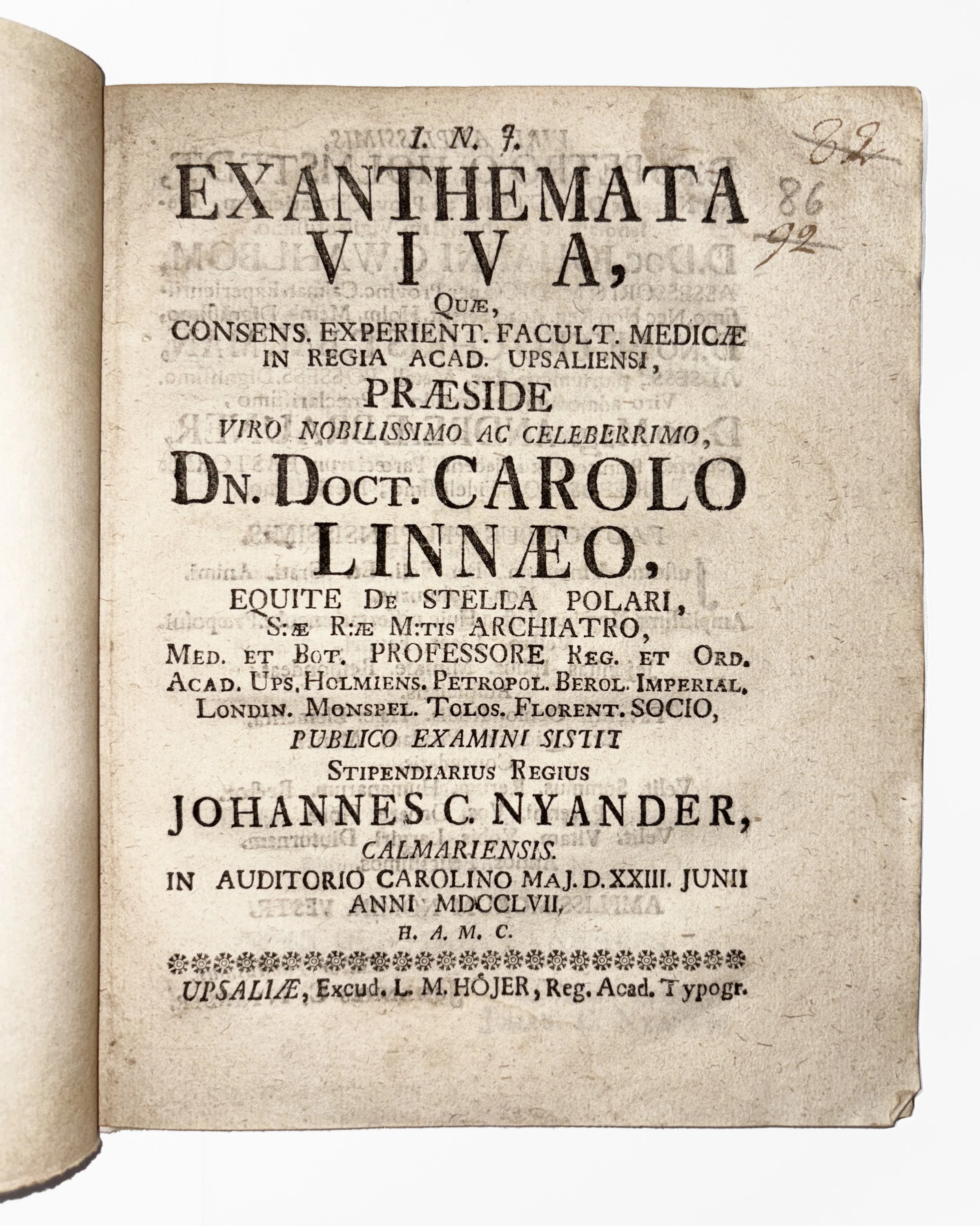
LINNAEUS, Carl (1707–1778); [NYANDER, John]
Exanthemata viva, quae, consens. experient. Facult. Medicae in Regia Acad. Upsaliensi, praeside viro nobilissimo ac celeberrimo, Dn. Doct. Carolo Linnaeo […]
[n.p.], [Uppsala], 1757
Small quarto (185 x 147mm); pp. 16
The most comprehensive early statement of the germ theory of disease, which did not take its modern form until a century later, in the work of Robert Koch and Louis Pasteur.
Although purportedly a thesis by the otherwise unknown John Nyander, the text was – as was custom – written by Linnaeus for Nyander to defend. As Kärrholm and others have shown, Swedish theses from this period were often part of the scientific avant-garde.
Generalized notions of the spread of disease by airborne contagions are ancient, but in the early-modern period a number of natural philosophers and medics attempted to investigate the question more thoroughly. In fact the present thesis accurately describes the theories of Kircher and Fracastorius as relying on the discredited theory of spontaneous generation. Linnaeus, meanwhile, made use of the discoveries of Antonie van Leeuenhoek. ‘To summarize,’ writes one historian, the Exanthemata viva argued
that all eruptive diseases were caused by living pathogens, that each disease was specific to its causative organism, and that, because of differences in the viability of these organisms, some of these diseases could be transmitted only by contagion, at least in certain climates, whereas others could be caused by organisms that persisted in particular sites such as wooden drinking vessels.
Nor was Linnaeus’ work merely an aside in the history of medicine. The Exanthemata viva was noticed by, for example, John Pringle, physician-general to the Army, who cited the work in the fourth (1764) edition of his influential Observations on the Diseases of the Army.
Rare: LibraryHub records only 5 copies in the UK, and OCLC finds copies only at Harvard, Yale and McGill in North America.
References: Kärrholm, Swedish Dissertations and their Subjects, 1600–1820, Vol. 2, No. 10580, DeLacy, Contagionism Catches On, Ch. 4.
Very good; bound in modern marbled-paper wrappers.