

BABBAGE'S DIFFERENCE ENGINE: OFFPRINT OF THE FIRST EVER REPORT ON AUTOMATIC COMPUTING (1823)
BABBAGE'S DIFFERENCE ENGINE: OFFPRINT OF THE FIRST EVER REPORT ON AUTOMATIC COMPUTING (1823)
BABBAGE, Charles (1791–1871)
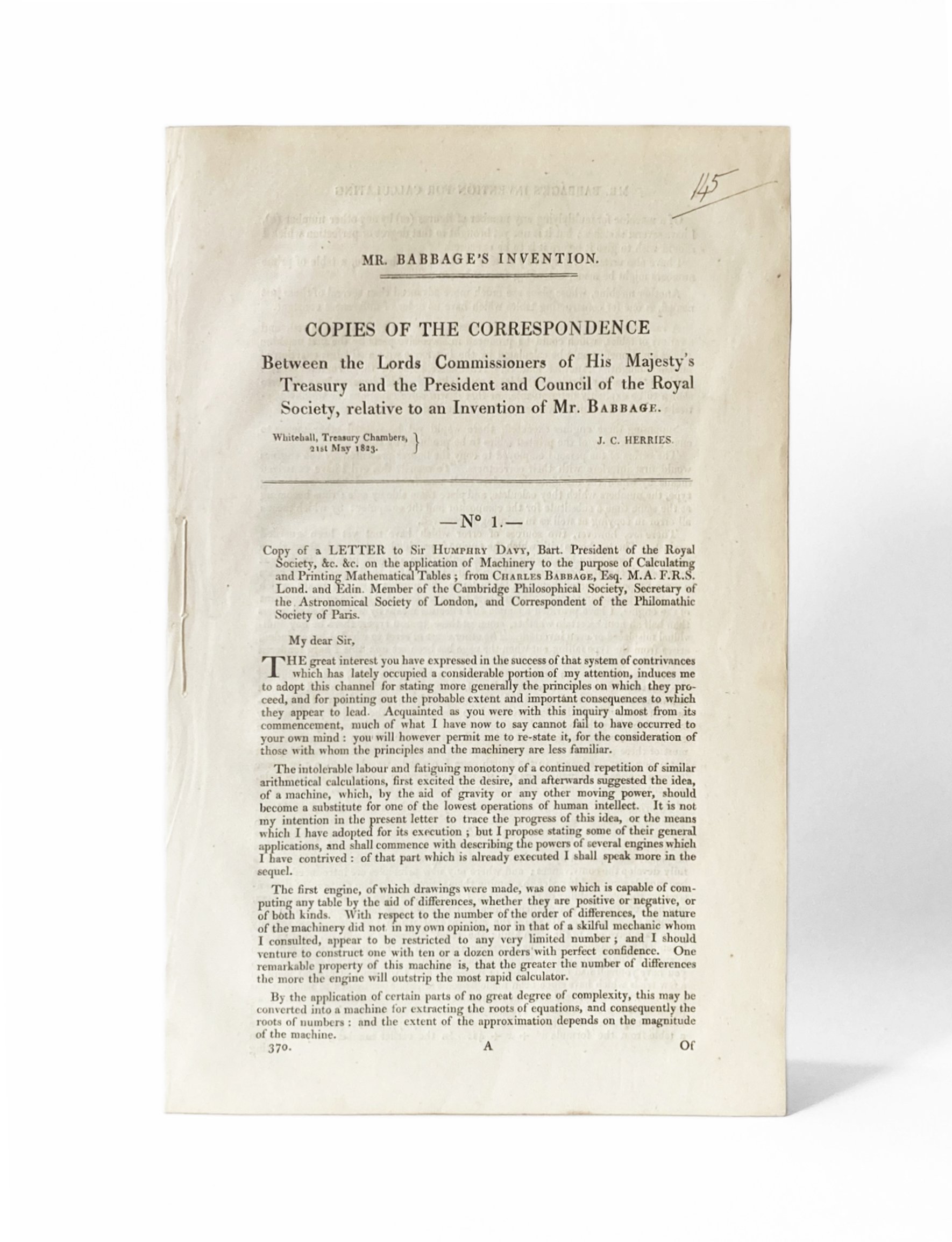
[OFFPRINT] Mr. Babbage's Invention. Copies of the Correspondence Between the Lords Commissioners of His Majesty's Treasury and the President and Council of the Royal Society, relative to an Invention of Mr. Babbage [INCLUDING]: A letter to Sir Humphry Davy, Bart. on the application of machinery to the purpose of calculating and printing mathematical tables
Published by House of Commons, London, 1823
Folio; pp. [8]
THE DIFFERENCE ENGINE GAINS THE SUPPORT OF DAVY, THE ROYAL SOCIETY, AND THE BRITISH GOVERNMENT. An exceptionally scarce and important document. This is the sole separate printing of the parliamentary record ('Sessional Papers') containing Babbage's celebrated letter to Humphry Davy, as well as the favourable response of the Royal Society. Only one other copy is recorded worldwide, at the University of Illinois; however, the present copy is the only known example to retain its original stab-stitching, i.e. to be offered in the pristine 'as issued' state.
Although many calculating machines predate the Difference Engine, Babbage’s machine marks a decisive break: Babbage wanted not only to mechanize calculation, but to automate it. Babbage’s intention was to improve the compilation and printing of astronomical and other mathematical tables, which were of supreme importance – notably in navigation – and which Babbage and others had found to be riddled with errors.
The Difference Engine was a mechanical calculator that computed values using the method of finite differences, a technique that replaces multiplication and division with repeated addition. In this method, a polynomial function is represented by a sequence of values and their successive differences – first differences, second differences, and so on – which eventually become constant. By storing these initial values in columns of geared wheels, the machine could update each value by adding the one below it in a cascading process. With each turn of the mechanism, the engine advanced the calculation by one step, propagating changes through the columns and producing the next value in the sequence automatically.
The present document marks the moment when Babbage's Difference Engine went from an inventor’s dream to a reality – albeit one only ever partially completed. Having created a model of his Difference Engine in the early 1820s, Babbage sought public support, writing with extensive detail of the project to the most famous scientist in the land – Humphry Davy, then President of the Royal Society. With Davy's backing, the Royal Society's response was decisive: a grant to Babbage was made, and production began in earnest.
Babbage’s principal engineer was Joseph Clement, a highly skilled machinist responsible for constructing the intricate precision parts required. Over roughly a decade of active development, disagreements over costs, design changes, and workshop arrangements led to tensions between Babbage and Clement, eventually causing the project to stall by the early 1830s. Despite significant progress on components, the engine was never completed during Babbage’s lifetime.
Nevertheless, the Difference Engine marks a decisive moment in the history of computing. This was the machine that Ada Lovelace became fascinated by shortly after her first meeting with Babbage, and she visited Babbage many times in order to see it in action. Babbage’s thinking on the Difference Engine developed through the 1820s and eventually he began to conceive of a general-purpose computing machine, the never-built Analytical Engine, also analysed and even ‘programmed’ by Lovelace.
Nor was the Difference Engine itself a practical failure: a number of machines were made by others, notably Per Georg Scheutz and George B. Grant.
Full contents of the present offprint:
Copy of a LETTER to Sir HUMPHRY DAVY, Bart. President of the Royal Society, &c. &c. on the application of Machinery to the purpose of Calculating and Printing Mathematical Tables; from CHARLES BABBAGE, Esq. M.A. F.R.S. Lond, and Edin. Member of the Cambridge Philosophical Society, Secretary of the Astronomical Society of London, and Correspondent of the Philomathic Society of Paris.
Copy of a LETTER from GEO. HARRISON, Esq. to Sir H. DAVY, Bart, transmitting to him a Printed Letter (of which N° 1. is a copy) forwarded to the Lords of the Treasury by Mr. Babbage.
Copy of the REPORT of the ROYAL SOCIETY on the aforegoing Letter of Mr. Babbage.
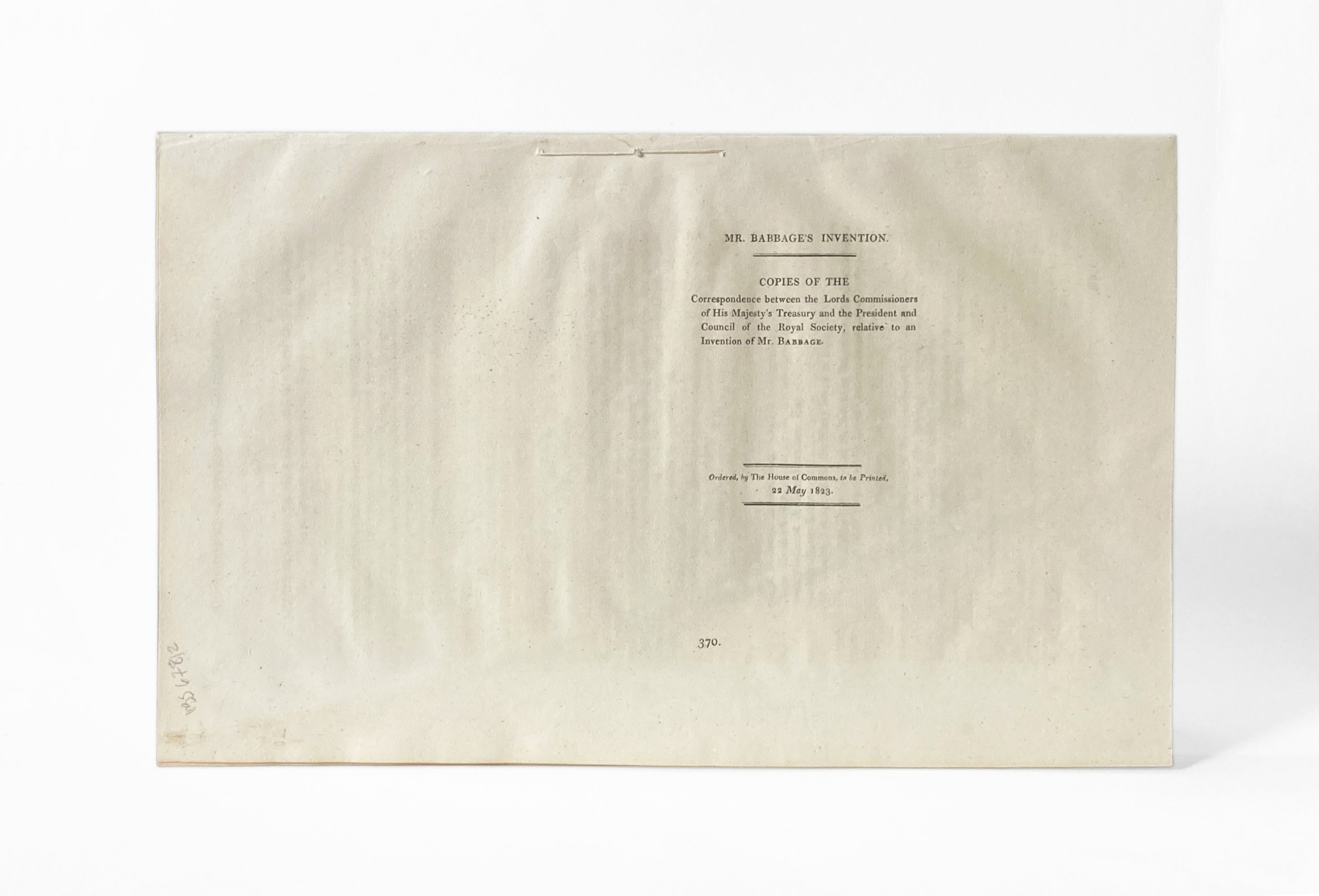
Near fine condition: stab-stitched as issued; docket title printed orthoganally to rear of last sheet; presented in an attractive custom-made folder with silk ties and a paper title to the cover.