

Ben Nicholson's reliefs: the origin story, in his own hand
Ben Nicholson's reliefs: the origin story, in his own hand
[NICHOLSON, Ben (1894–1982) – his copy]
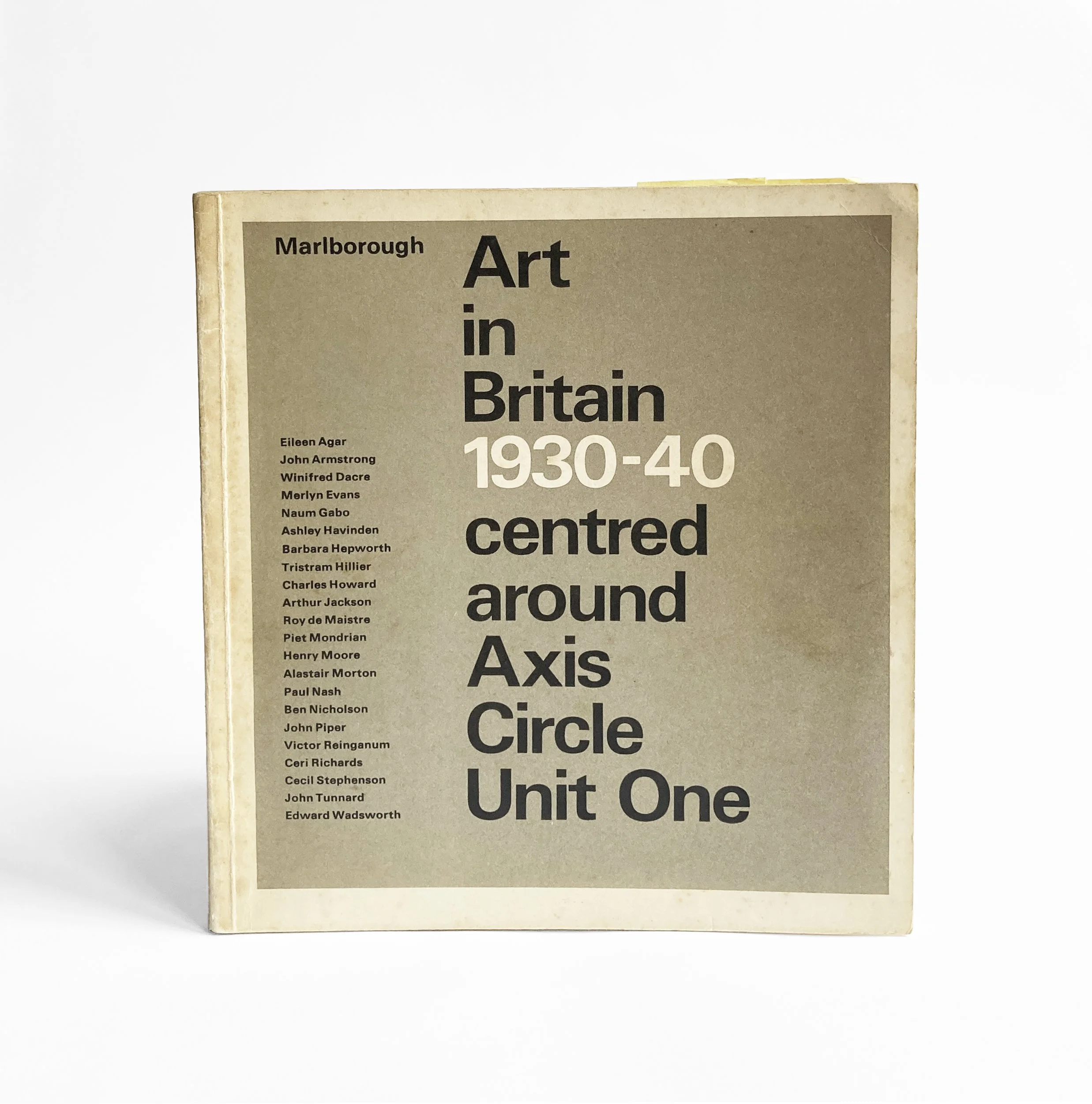
Art in Britain 1930–40 centred around Axis, Circle, Unit One
Marlborough Fine Art Ltd: London, [1965]
Square format softcover, 208 x 208mm; pp. 92
Good condition: covers somewhat marked and grubby; internally very good
An extraordinary insight into one of the turning points in British modernism – the origin of Ben Nicholson’s white reliefs.
Ben Nicholson’s annotated copy of the catalogue for the landmark Marlborough Gallery retrospective on interwar British modernism, bearing a significant manuscript biographical statement.
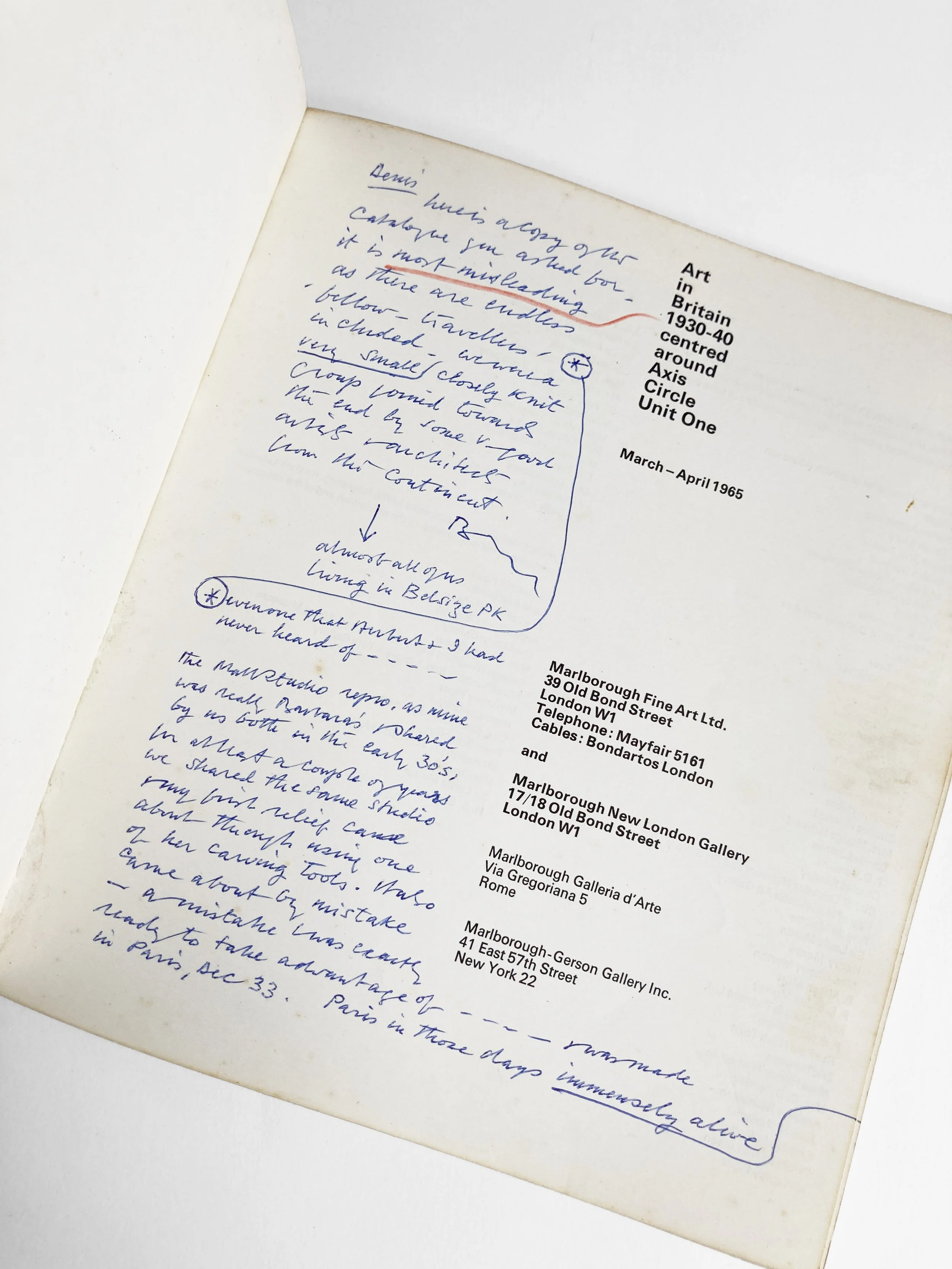
Nicholson has presented the copy to fellow sculptor Denis Mitchell, writing a critical comment about the artists selected for the show: ‘there are endless fellow-travellers included’.
This leads Nicholson to reflect on the nature of his own group:
We were a very small closely knit group joined towards the end by some v good artists & architects from the continent.
Here Nicholson signs off with his characteristic scraweled ‘B...’
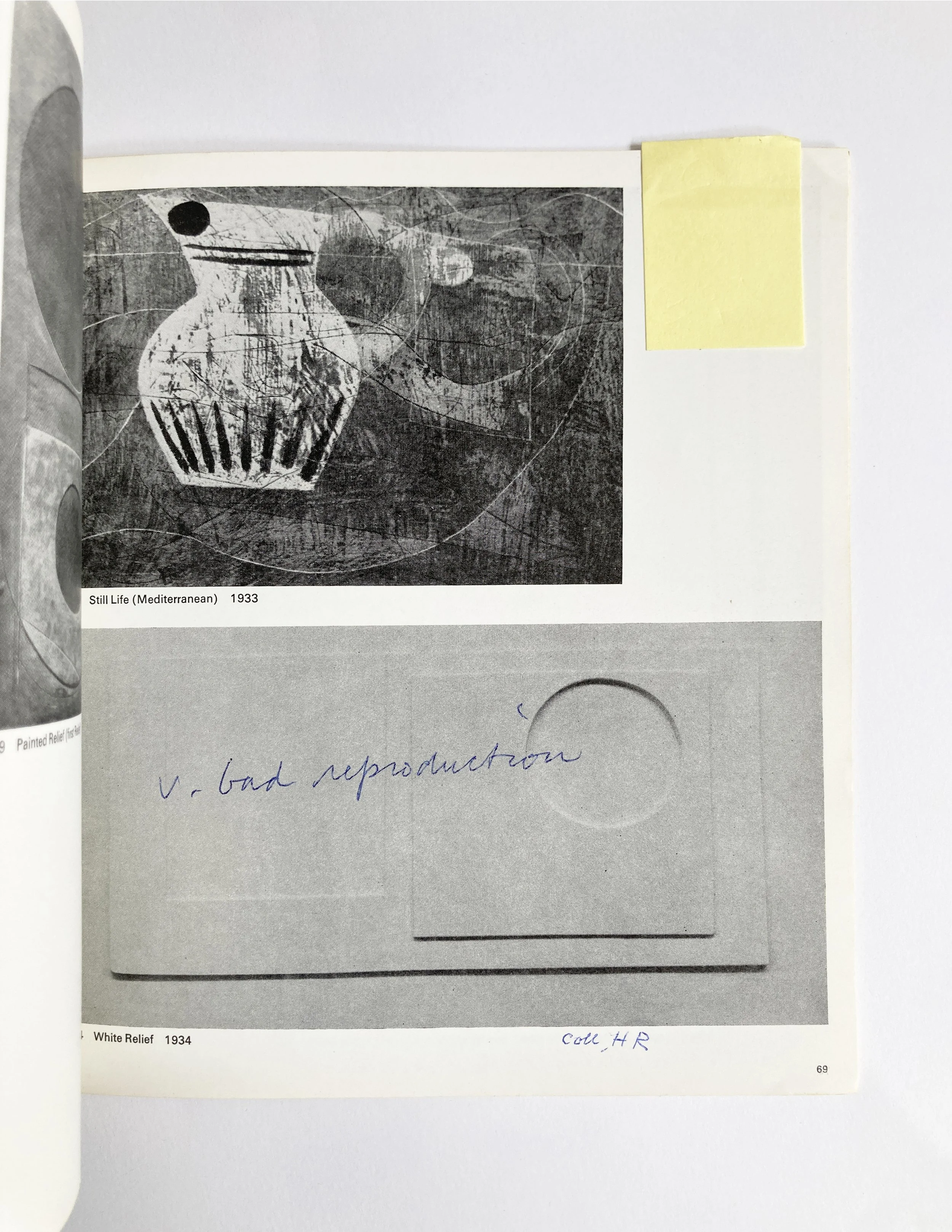
Later in the catalogue Nicholson has identified an image of a 1934 white relief as a ‘v bad reproduction’, and this seems to have spurred him to go back and add a crucial addendum to his comment to Mitchell:
as mine [i.e. my studio] was really Barbara’s & shared by us both in the early 30’s, for at least a couple of years we shared the same studio & my first relief came about through using one of her carving tools
Nicholson even goes as far as to date this precisely:
It [i.e. carving in relief] also came about by mistake – a mistake I was exactly ready to take advantage of... & was made in Paris, Dec 33. Paris in those days immensely alive
This provides vivid and important context for statements Nicholson made at the time he began relief carving. For example, on 12 December 1933 he had written to Hepworth: 'I did a very amusing thing yesterday. I carved it all day long it is about the size of a sheet of notepaper & looks like a primitive game. Jake and Kate came in at various stages & we rolled a marble about on it'.
It also dovetails with the specific details given by Nicholson at other points in the 1960s, when he was asked about his practice of relief carving by Herbert Read and Charles Harrison. However, the present framing is somewhat different from those accounts, especially the sentiment that this was ‘a mistake I was exactly ready to take advantage of’.
Nicholson’s relief carvings are considered among the most significant achievements of British modernism, and a defining contribution to the development of abstract art in Britain. Nicholson, here and in the letters to Read and Harrison, was keen to emphasise his independence from the European abstract tradition. But the reliefs are now seen as emerging from his engagement with Cubism and the international avant-garde of the early 1930s. The carvings’ austere white surfaces, shallow projections and carefully balanced circles and rectilinear forms place them in close dialogue with the ideals of Mondrian, De Stijl and Abstraction-Création. But as is evident from this and other sources, there is also a strong connection to the sculptural practice of Barbara Hepworth.
One of the largest and finest of Nicholson’s reliefs, '1936 (white relief), sold for £1,842,000 at Christie’s in London in March 2022.