

Barnes Wallis' annotated copy of the R.101 report
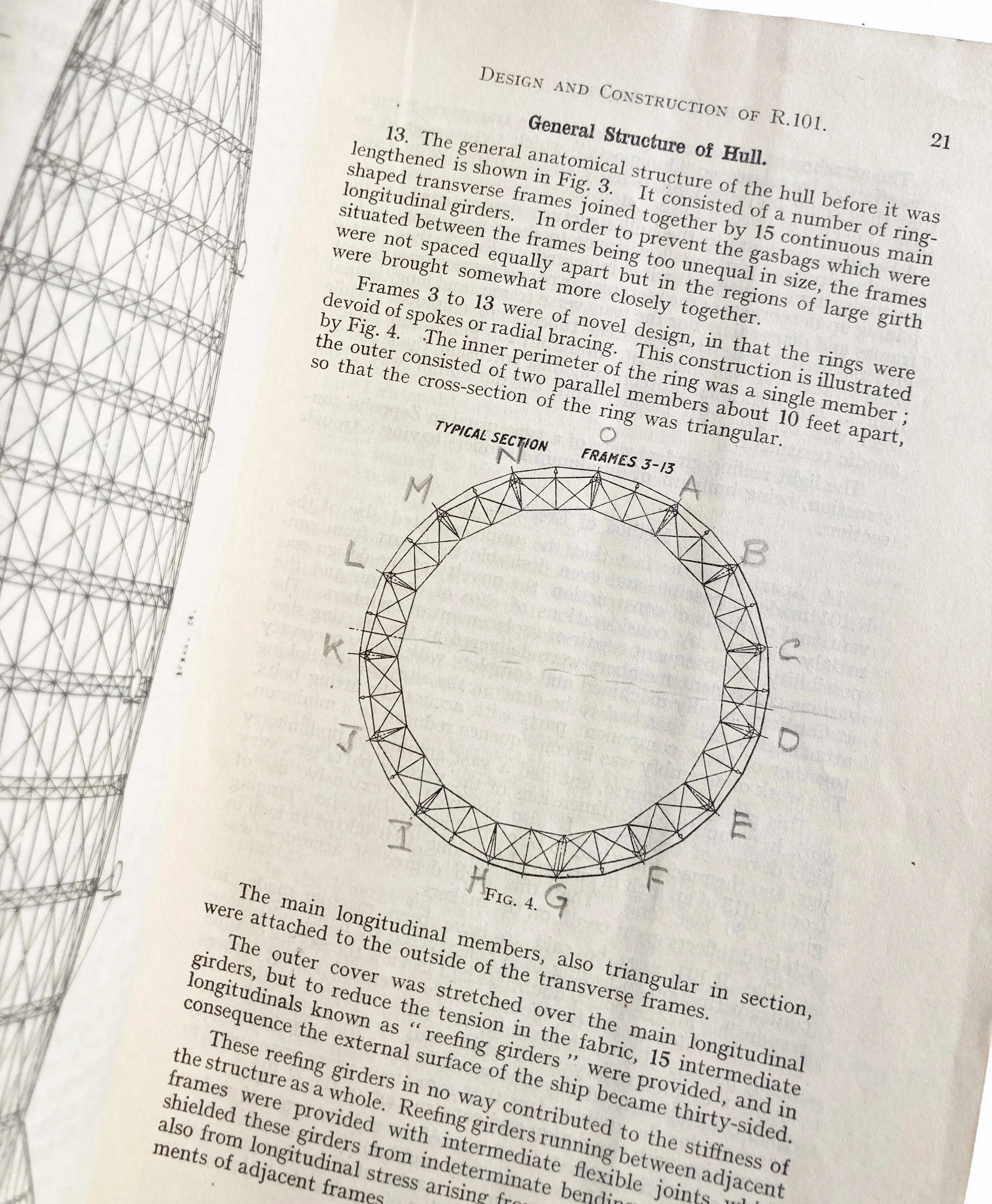
Barnes Wallis' annotated copy of the R.101 report
[WALLIS, Sir Barnes Neville (1887–1979) – his copy]; MACKENZIE, Sir William (1860–1942); SIMON, John, 1st Viscount Simon (1873–1954), et al.
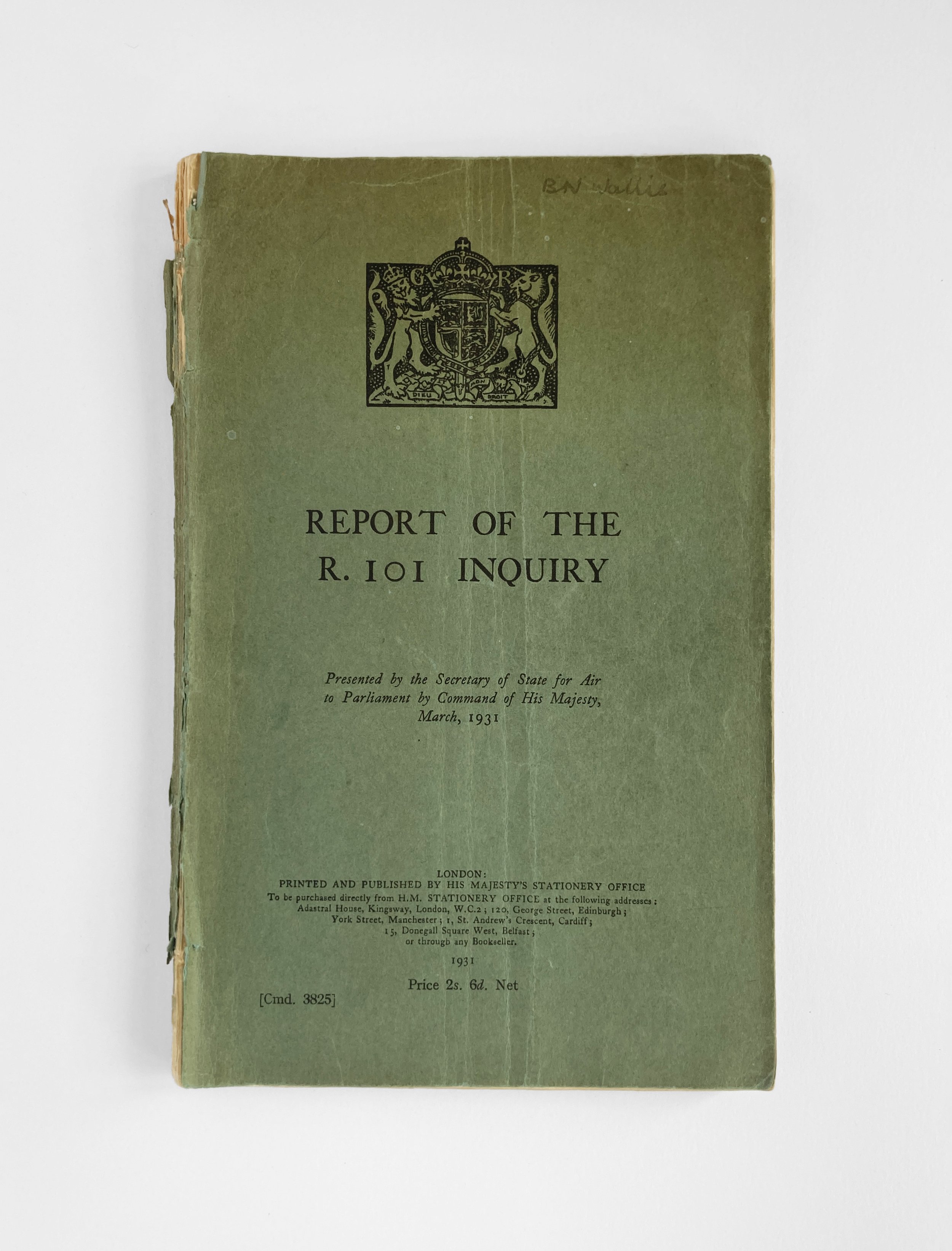
Report of the R.101 Inquiry
London: HMSO, 1931
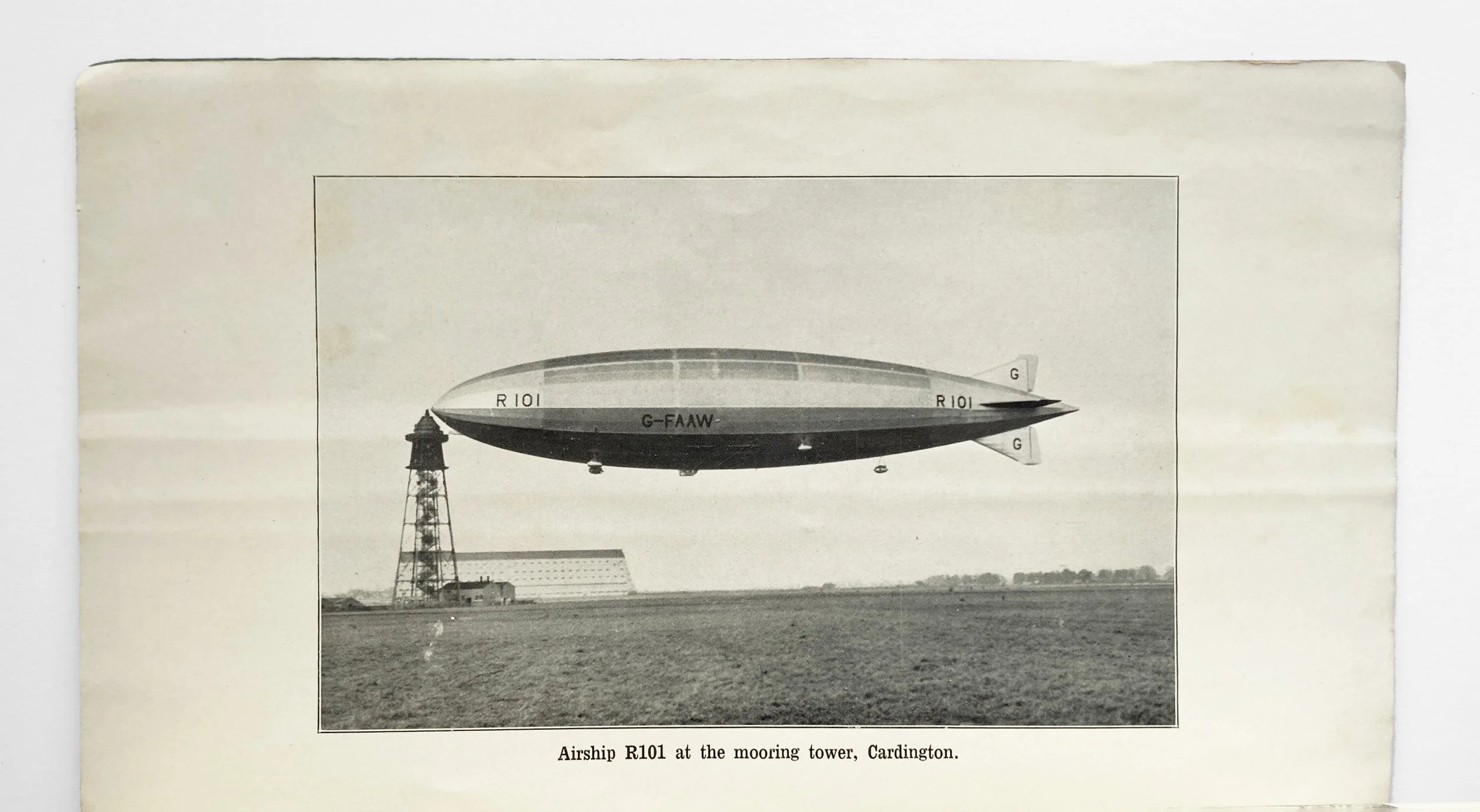
Perfect-bound pamphlet in green printed wraps; large 16mo, 243 x 154mm; pp. 129, [frontispiece, full-page plate, and two folding plates]
Condition fair: front cover almost detached, with loss to the top and bottom of the spine; contents very good, with Barnes Wallis’ pen and pencil annotations to more than a dozen pages; ‘BN Wallis’ in ink to the upper right of the front cover
An exceptional copy of the report into the R.101 disaster – the crash that effectively ended the British airship programme. Engineer Barnes Wallis’ heavily annotated personal copy, revealing his disagreements with the committee and opinions on the crash, not recorded elsewhere, and all the more powerful as Wallis had been excluded from the inquiry.
The British airship R.101 crashed on 5 October 1930 during its maiden overseas voyage to India, coming down in northern France after struggling in bad weather and losing altitude. It burst into flames on impact, killing 48 of the 54 people on board, including key designers and government officials, including the Secretary of State for Air, Christopher Birdwood Thomson, 1st Baron Thomson. This brought an immediate halt to airship development in Britain – to be followed by similar disasters and halted airship programmes in the US and eventually Germany.
Wallis’s connection to the tragedy could hardly have been closer. He had been involved in airship design since 1913, and was a personal friend and colleague of many of those who died. He had also been the lead designer of the R.100, built by the Airship Guarantee Company (a subsidiary of Vickers-Armstrongs), and a direct rival of the doomed R.101. The intense competition between the teams of the two airships is wonderfully described in Jack Morpurgo’s biography, as is Wallis reaction to the crash:
Scarcely twelve hours later [i.e. following the R.101’s departure] the telephone rang at White Hill House, Effingham. Wallis answered and was for a moment bad tempered with the Weybridge colleague who seemed unable to bring out his reasons for a call at such an hour. Then truth broke through the stammerings: R.101 was down at Beauvais, only 7 hours 24 minutes out from Cardington, and all but six of her complement of fifty-four dead or dying. Wallis clung to the ‘phone, saying nothing, so that his informant thought he had not heard and started to tell his story all over again. Wallis thanked him, hung up and sat on the edge of his bed staring blankly into his memories.
This reflective phase likely did not last too long. Wallis had long had doubts about the viability of the R.101, and more particularly about the talents of its lead designer Lieutenant-Colonel Vincent Crane Richmond – one of those who perished in the crash. Shortly after the disaster (and before he could possibly have known any details) Wallis wrote to a friend ‘I think it will be definitely established [...] that the failure of the R.101 was due to inherent defects in certain parts of her design’. But Wallis was never given the chance to test his hypothesis, at least in public, as he and all other members of the R.100 team were omitted from the committee that investigated the R.101 crash.
Indeed Wallis assumption about poor design was contradicted by the report, which was seen by some as a ‘whitewash’ intended to absolve both crew and designers of blame, presenting the material in a confusing manner and finding that a sudden leak in the forward gasbags of the airship caused its rapid decent.
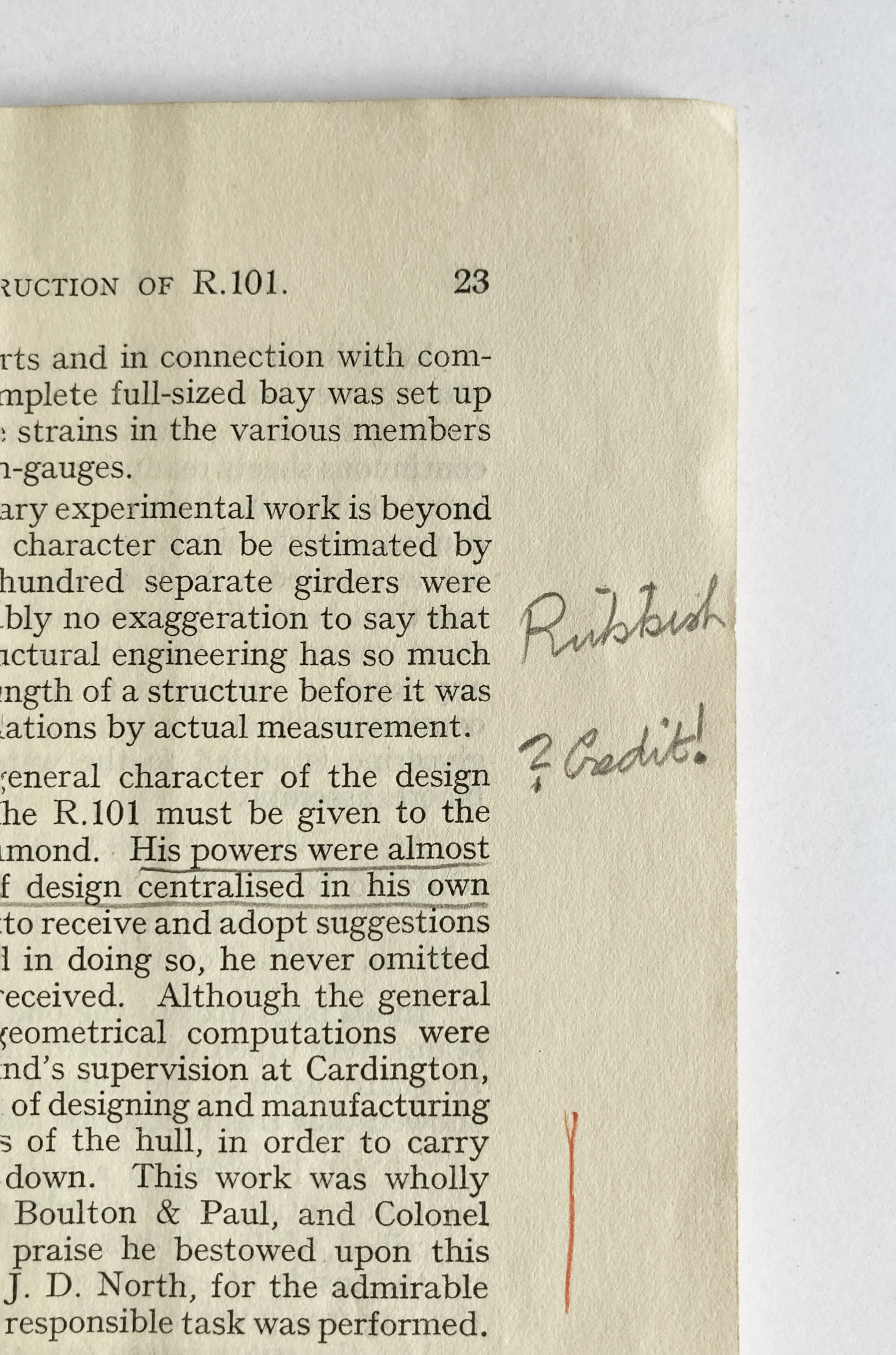
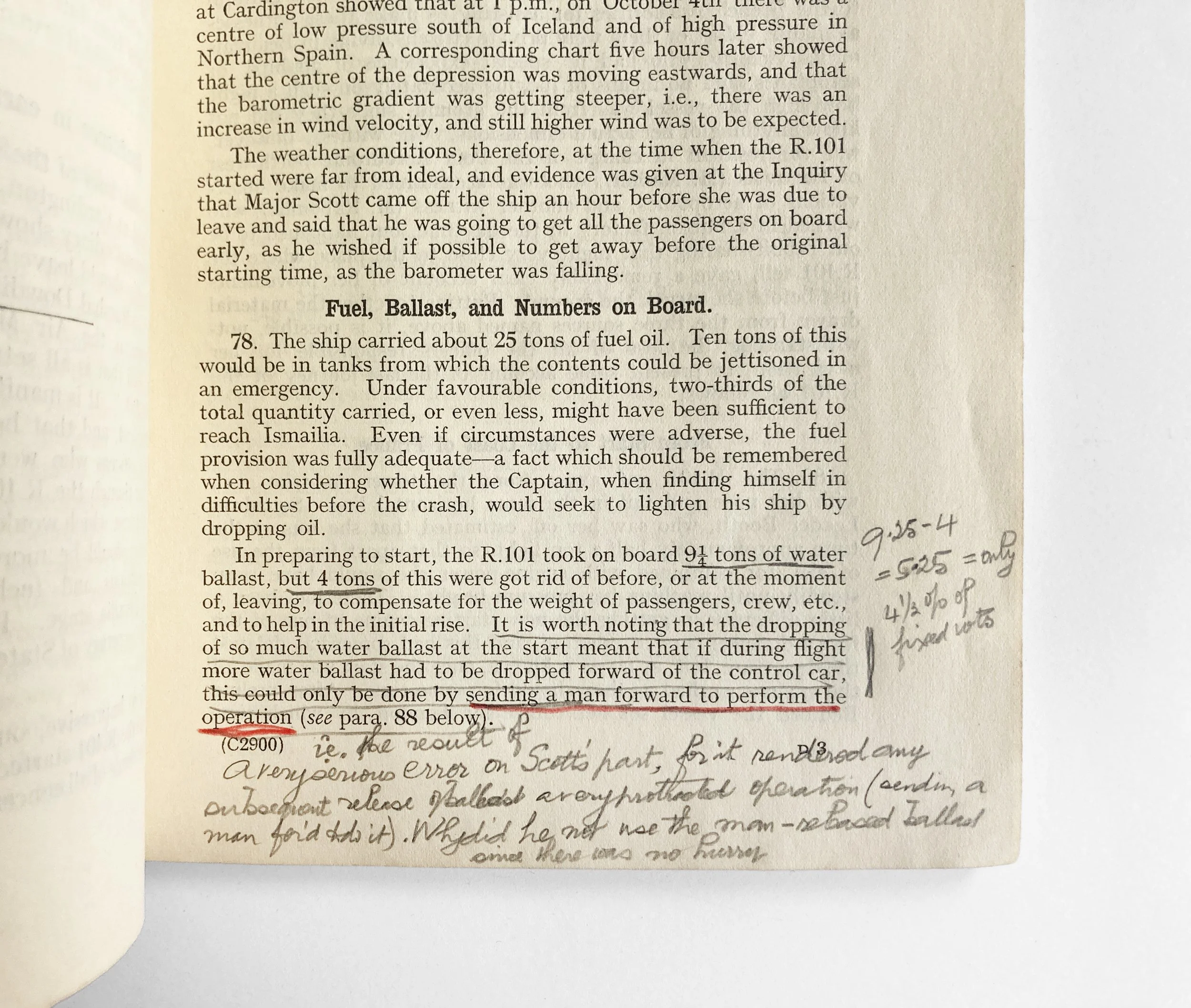
Here, in the margins of the official report, we can see Wallis formulating his rebuttal, identifying the initial loading of the airship, the poor design of the ballast-release system, and ultimately the reliance on dynamic lift of a very heavy ship as the causes of the crash. Early on Wallis leaves no ambiguity about his view of the matter, writing ‘Rubbish’ next to a comment about the extensive testing prior to the development of the R.101, and ‘? Credit!’ next to an assessment of Richmond’s work. Wallis’ friend Major George Herbert Scott (another victim of the crash) is said to have committed ‘a very serious error’, for his part in the loading of the R.101, but this is tempered later on, when Wallis instead blames ‘bad design, or lack of practical flying experience on Richmond’s part’, for the consequences of Scott’s decision.
The most substantial comments, however, are those that relate to the notion that the R.101 suffered ‘stalling of the horizontal fins’ (Wallis’ annotation to p. 87). Here Wallis formulates what was to become his final verdict on the catastrophe.
Although it put paid to the development of airships, Wallis had in fact already moved on to work on heavier-than-air flight, and was of course to change tack again during World War II. Ultimately the effect of the crash on Wallis was as much about the psychology and public position of the engineer as it was about personal connections or technical details. As Morpurgo notes, Wallis felt he had missed the chance to take a more active involvement with the R.101’s design, then to damn it more fully in public, perhaps leading to a delay in its fateful maiden voyage.
Provenance: Sir Barnes Neville Wallis (1887–1979)
References: Jack Morpurgo, Barnes Wallis: A Biography (1972), Chapter 10, ‘The End of Airships’