

Faraday on the electromagnetic field, 1852
Faraday on the electromagnetic field, 1852
FARADAY, Michael (1791–1867)
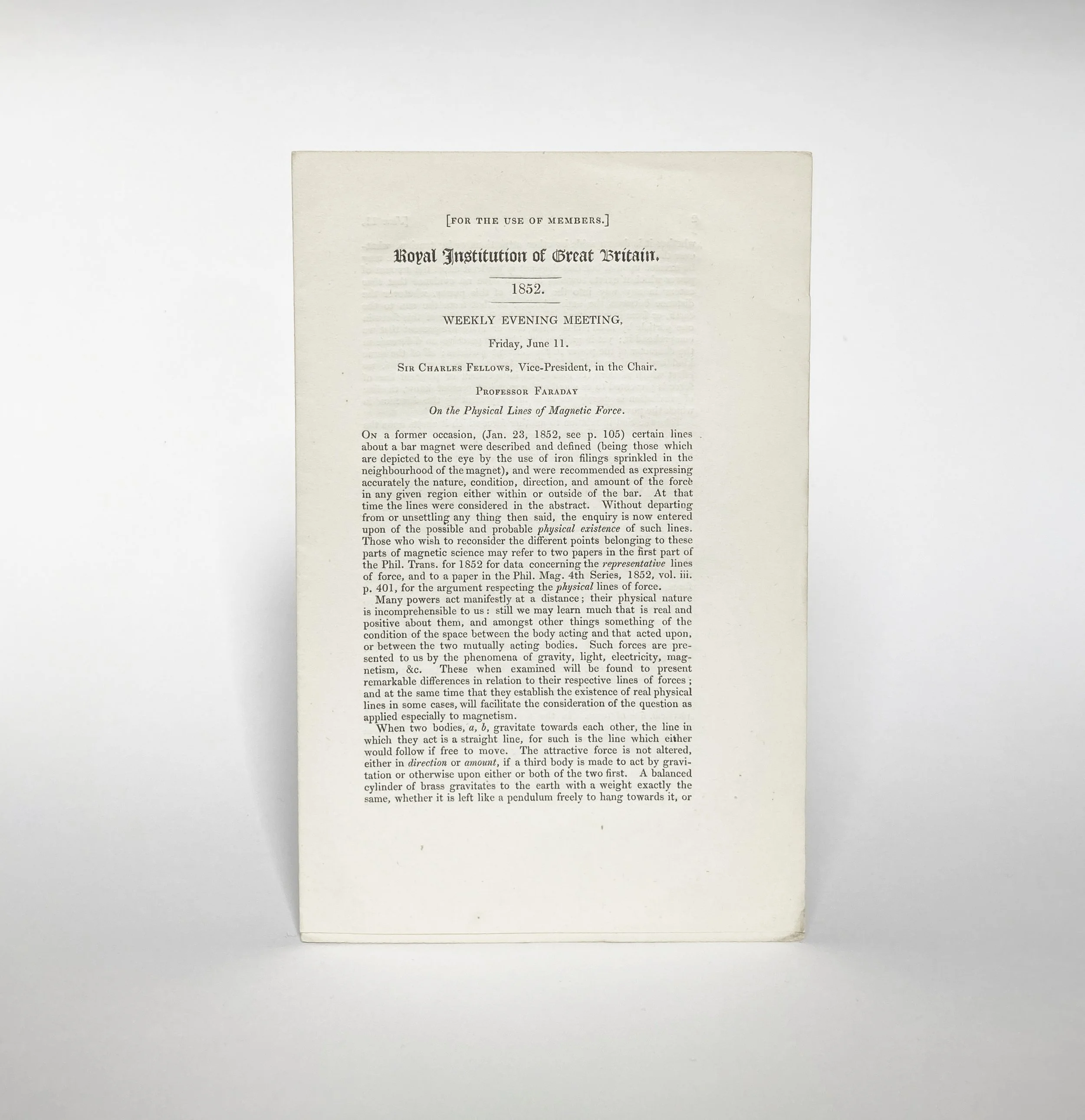
On the Physical Lines of Magnetic Force
London: Royal Institution, [1852]
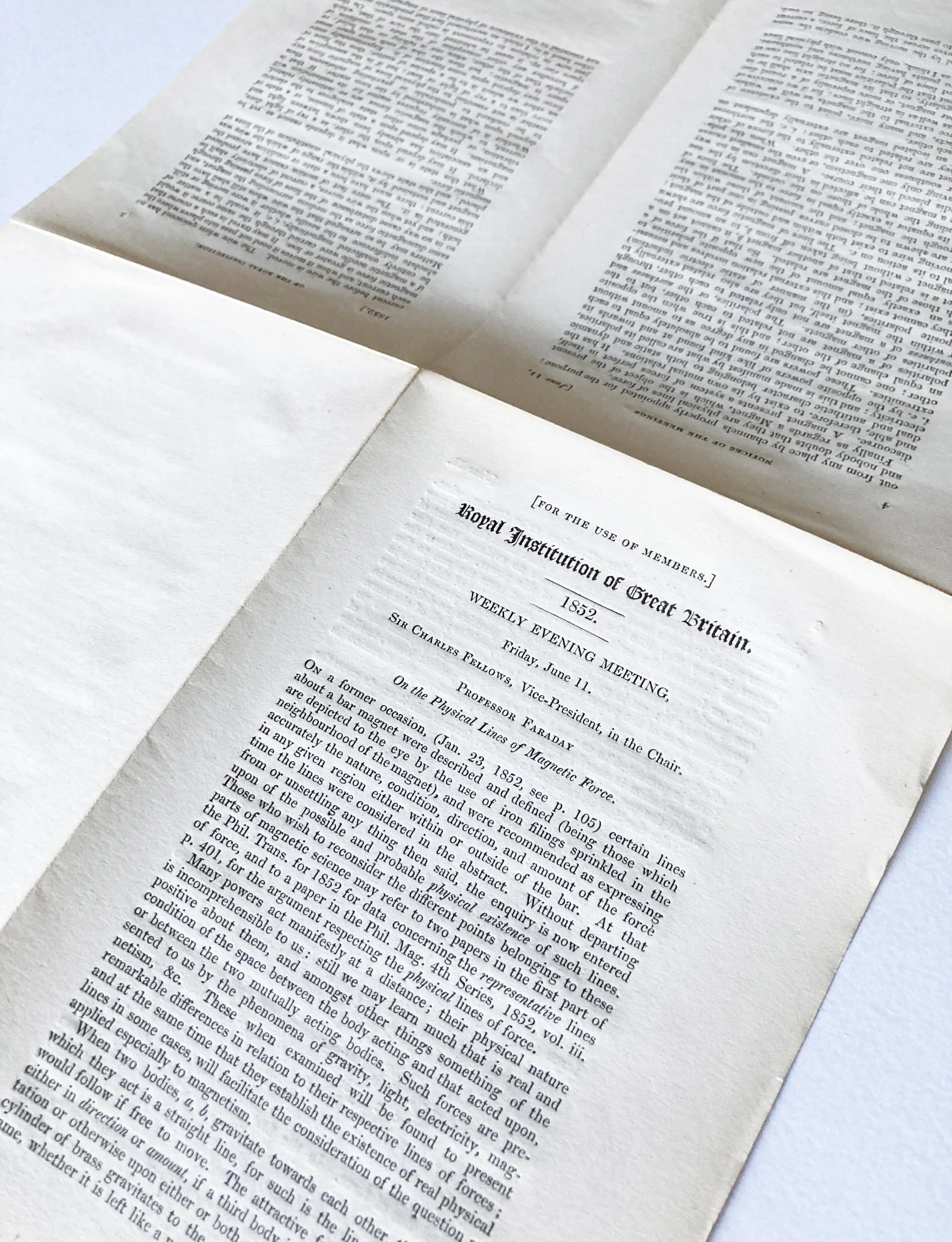
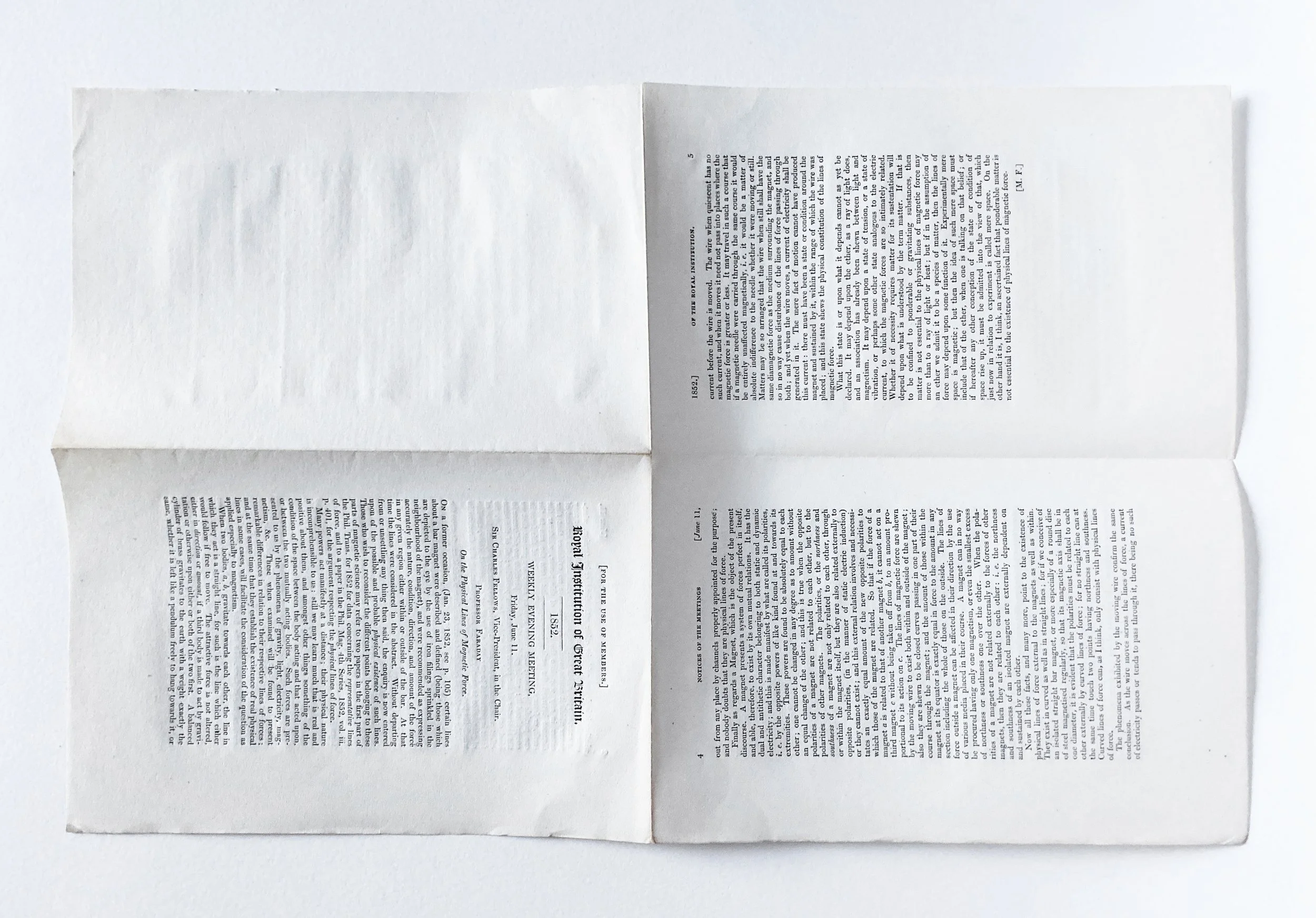
Single halved demy sheet (225 x 114mm) twice folded; 5pp.
Fine condition, noting only the very faintest darkening to the lower right-hand corner. Uncut, as issued
Essay
An exceptional copy of the separate printing of Faraday’s famous lecture, arguing for the physical reality of the ‘lines of force’, read to the Royal Institution on Friday 11 June 1852, with demonstrations.
Exceptionally scarce: no other copies recorded.
Faraday first developed his ideas about lines of force and the electromagnetic ‘field’ that they must comprise in the early 1830s – even taking the precaution of sealing an account of his theory in a vault in case he needed later to claim priority. He worked through the idea slowly, revisiting it in earnest only after his major period of experimental research into electricity and magnetism was concluded.
A few month’s prior to the present lecture, Faraday had given a more tentative account of the lines of force to the Royal Institution, hedging on the issue of their physical reality. By June he was more confident, writing, in the text offered here:
Many powers act manifestly at a distance; their physical nature is incomprehensible to us: still we may learn much that is real and positive about them, and amongst other things something of the condition of the space between the body acting and that acted upon […] Such forces are presented to us by the phenomena of gravity, light, electricity, magnetism, &c.
Faraday’s physical intuition about fields and lines of force held the interest of the scientific community. But one man, very different in character from Faraday, would bring new methods to bear on the problem. This was James Clerk Maxwell, who in the 1850s was a young mathematician at the University of Cambridge. By placing Faraday’s work on sound mathematical foundations Maxwell was able to develop his famous field equations – the direct precursor to and inspiration for Einstein’s work on relativity.
References: Gribbin, Science: A History, pp. 411ff; Cox and Jeff Forshaw, Why Does e=mc2 (And Why Should We Care?), pp. 17–21