

The structure of DNA: Franklin, Crick, Watson, and Wilkins in Nature, 1953
The structure of DNA: Franklin, Crick, Watson, and Wilkins in Nature, 1953
CRICK, Francis (1916–2004); FRANKLIN, Rosalind (1920–1958); WATSON, James D. (b.1928); WILKINS, Maurice (1916–2004)
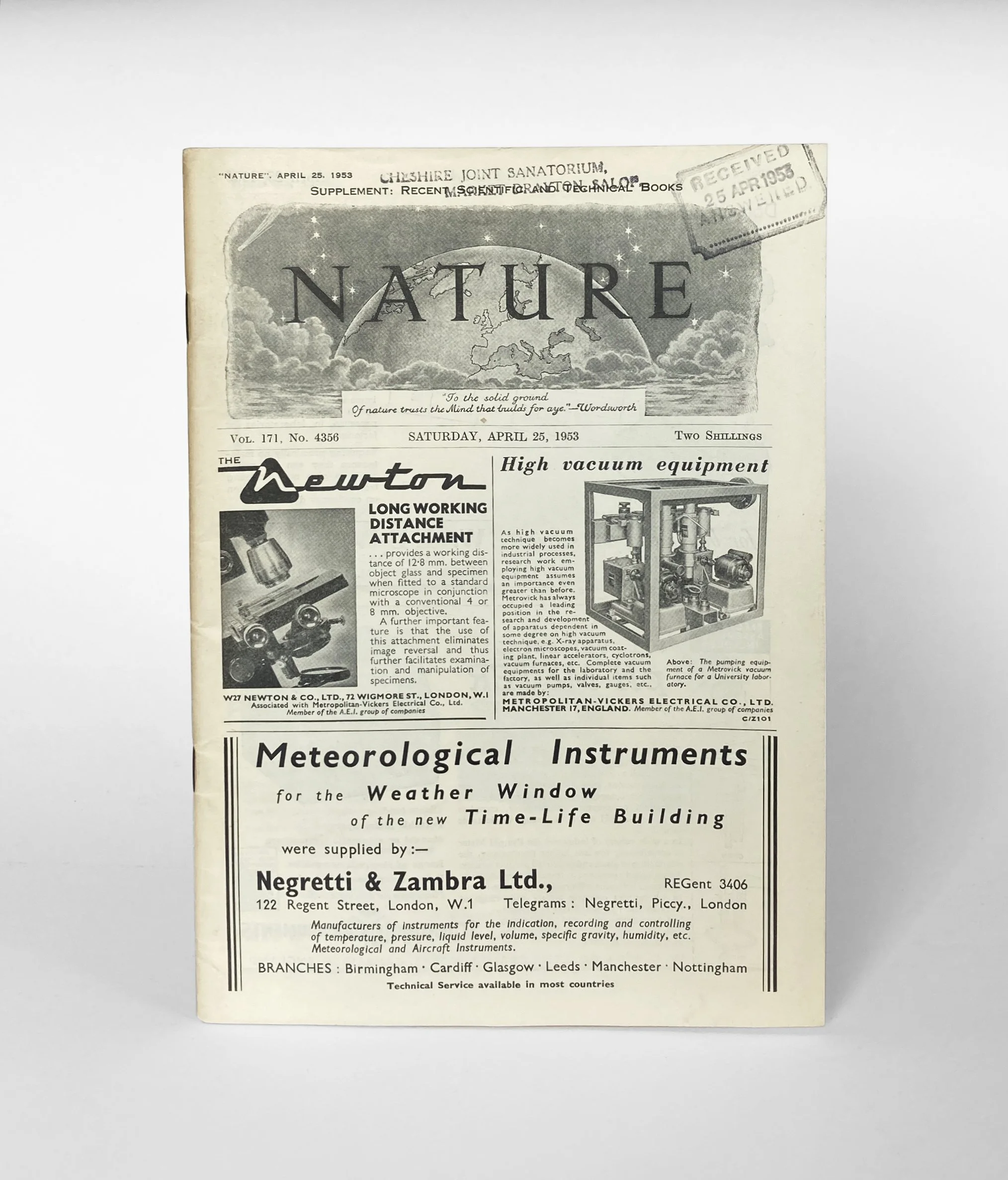
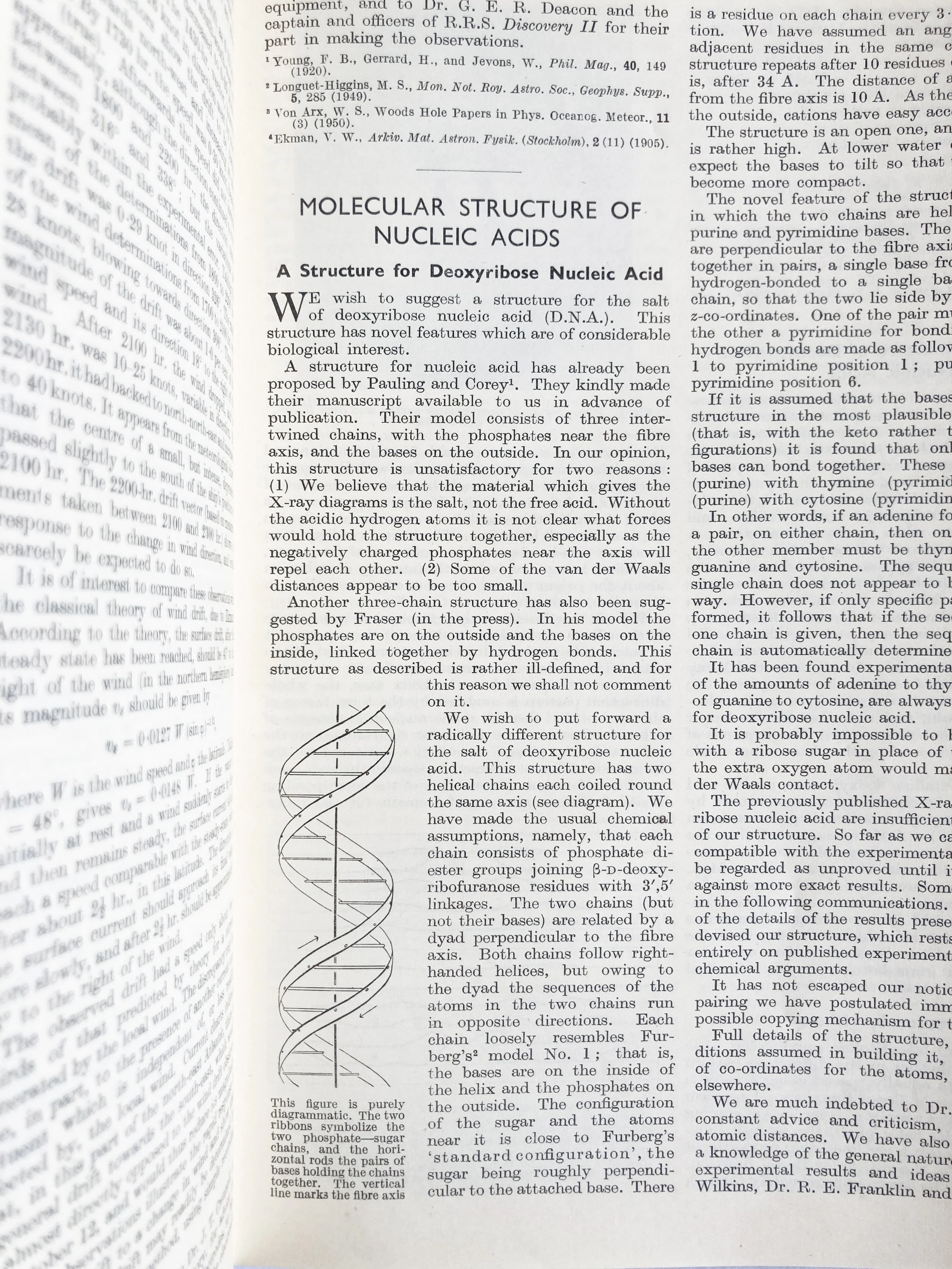
‘A Structure for Deoxyribose Nucleic Acid’ [with:] ‘Molecular Structure of Deoxypentose Nucleic Acids’ [with:] ‘Molecular Configuration in Sodium Thymonucleate’
[in:] Nature, Vol. 171, No. 4356
London: Macmillan, 1953
Large octavo (255 x 180mm); pp. cclxx–cclxxviii, [709]–732, i–xii [supplement], 733–758, cclxxix–cclxxvi
Single issue in self wraps as issued. Near fine condition; lower staple very slightly rusting; discreet library stamps
Essay
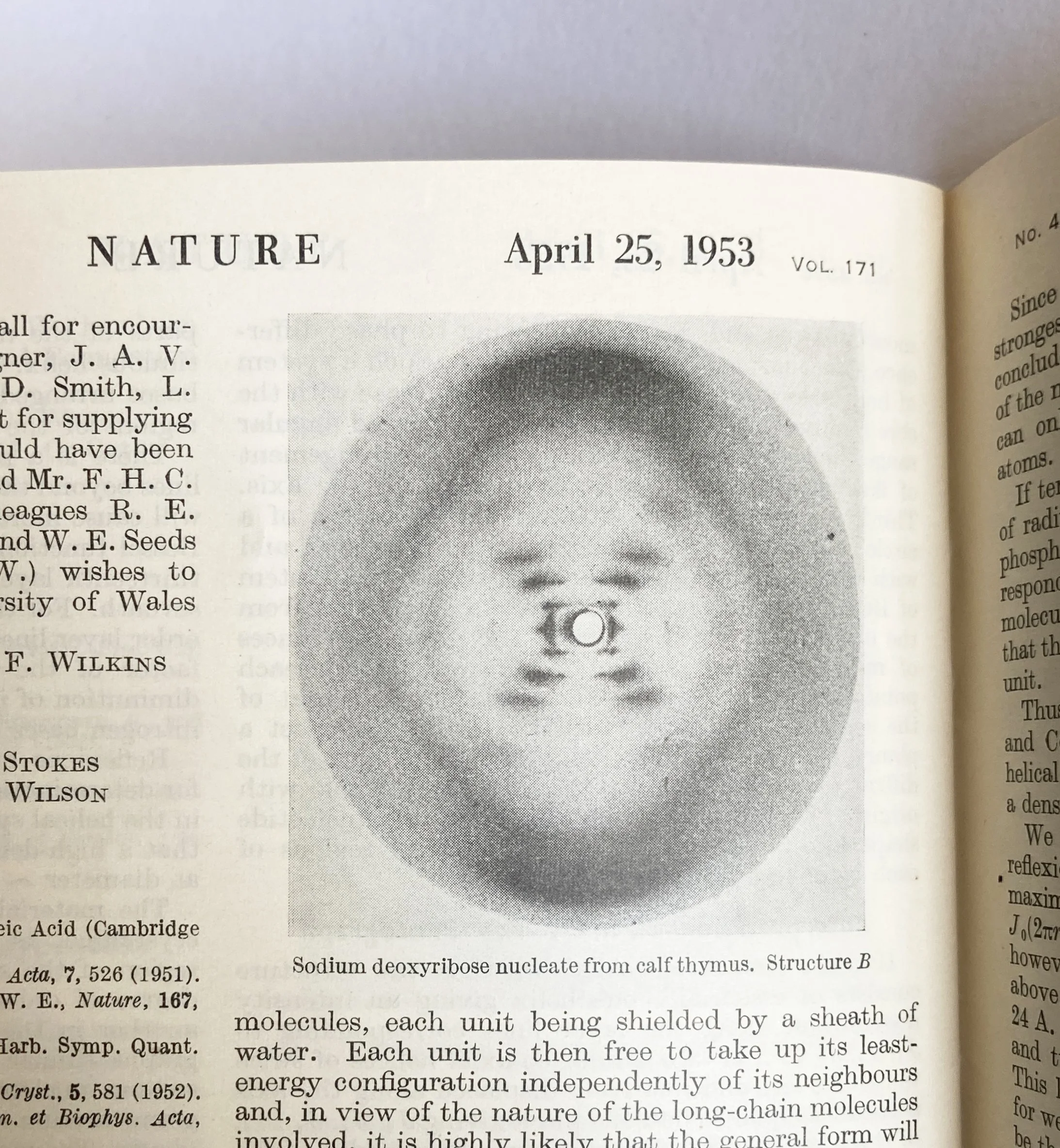
A landmark in the history of science, and one of a handful of the most important (sets of) scientific papers ever published. Crick and Watson announce their double-helical structure for DNA; Franklin and Gosling present ‘Photo 51’; Wilkins publishes the paper that will place him alongside Crick and Watson for the 1962 Nobel Prize (with Franklin having died in 1958).
The longer story of DNA goes back to the 1860s, and the discovery of ‘nuclein’ by the Swiss physiological chemist Friedrich Miescher. The chemical composition of what came to be called deoxyribonucleic acid was worked out in the early 20th century. Around the same time, new innovations in x-ray crystallography led to the idea of understanding the physical structure of biomolecules.
In 1944 a paper was published by Oswald Avery and his colleagues at Rockefeller University showing that hereditary units, or genes, are composed of dna. Inspired by this, Erwin Chargaff established his famous ‘rules’ that govern the ratios of the different nucleic acids.
By the early 1950s a number of research teams – at Cambridge and King’s College London – were close to solving exact arrangement in space the dna molecule. Notoriously, Jim Watson was given a glimpse of Franklin’s work by Maurice Wilkins, and this proved to be the final piece of the puzzle: on 25 April 1953 Nature published three papers in issue No. 4356, with Crick and Watson claiming the ‘prize’ of discovery, and the two King’s teams represented by their complementary papers – Franklin’s including one of the most famous scientific images ever printed, ‘Photo 51’.
Far from being the end of the race, however, this marked just the start of a revolution in molecular biology. As Crick and Watson wryly commented at the end of their paper:
It has not escaped our notice that the specific pairing we have postulated immediately suggests a possible copying mechanism for the genetic material.
The 1962 Nobel Prize honoured two of the teams – Crick and Watson’s, and Wilkins’ – and subsequent historians have rightly placed Rosalind Franklin and her colleagues back at the heart of the story.
Provenance:
Cheshire Joint Sanatorium, received on the day of publication
References:
Dibner, Heralds of Science, 200. Garrison-Morton 256.3; Judson, Eighth Day of Creation