

Rosalind Franklin's major paper on DNA, 1953
Rosalind Franklin's major paper on DNA, 1953
FRANKLIN, Rosalind (1920–1958) and GOSLING, Raymond (1926–2015)
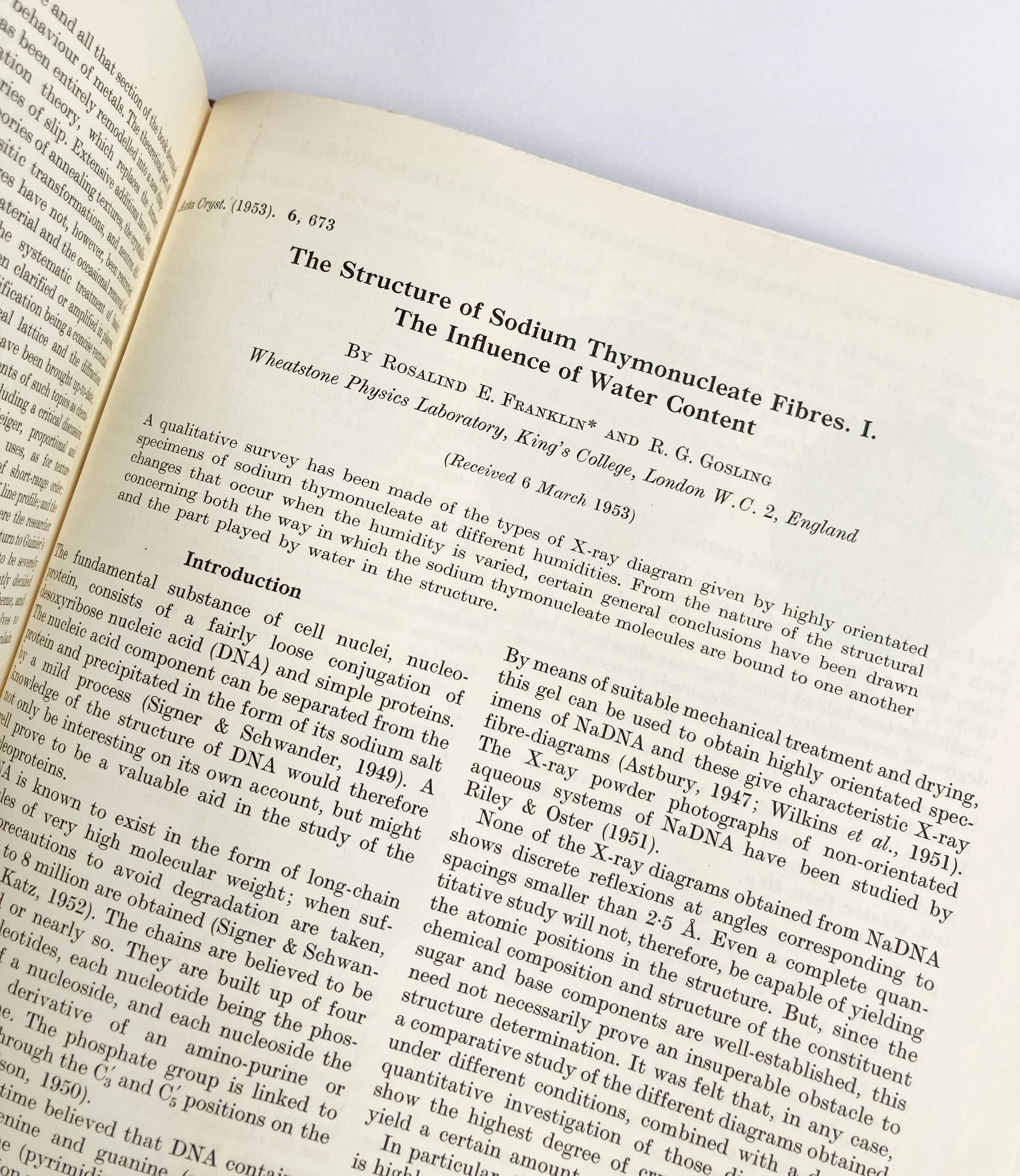
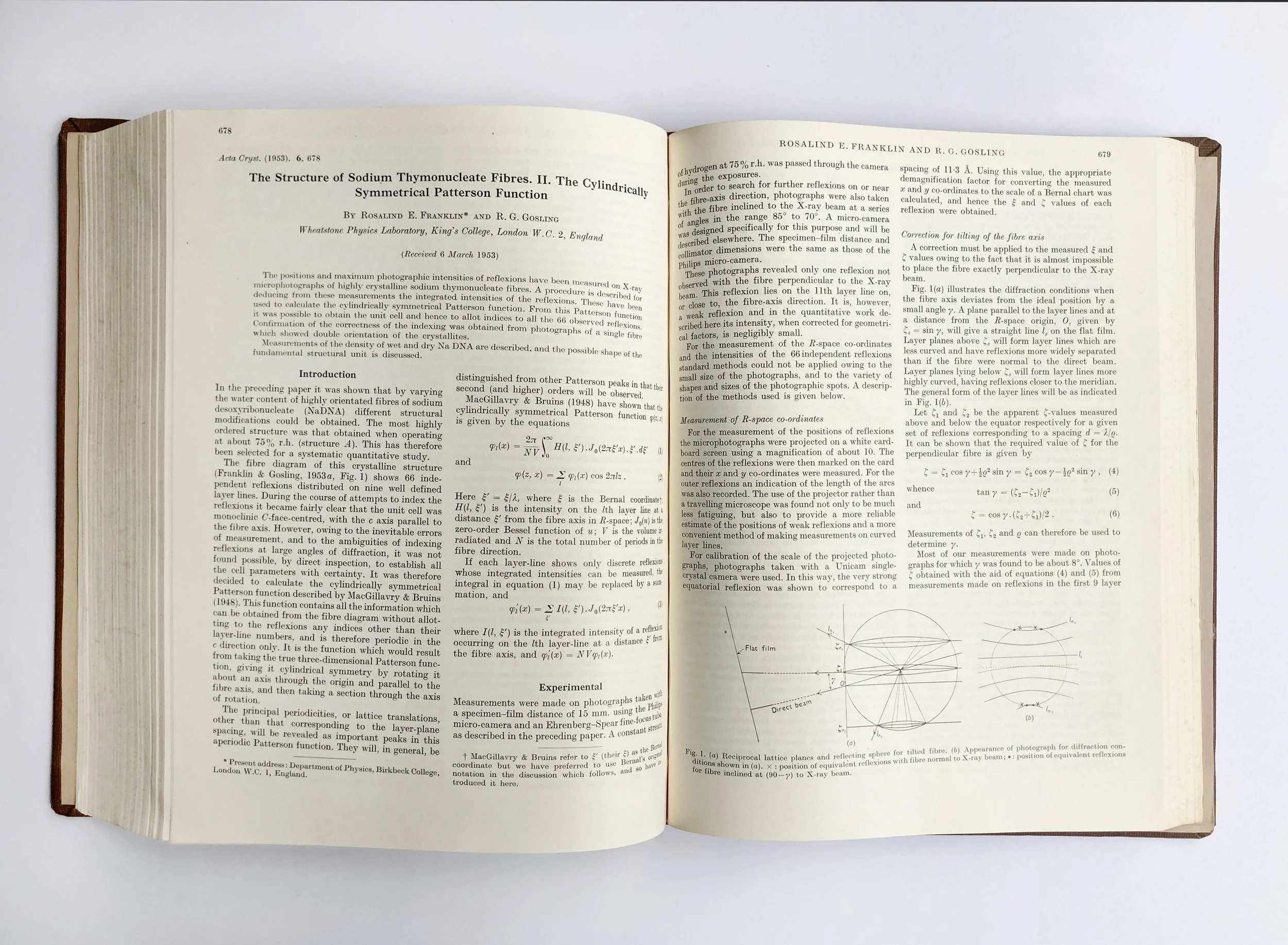
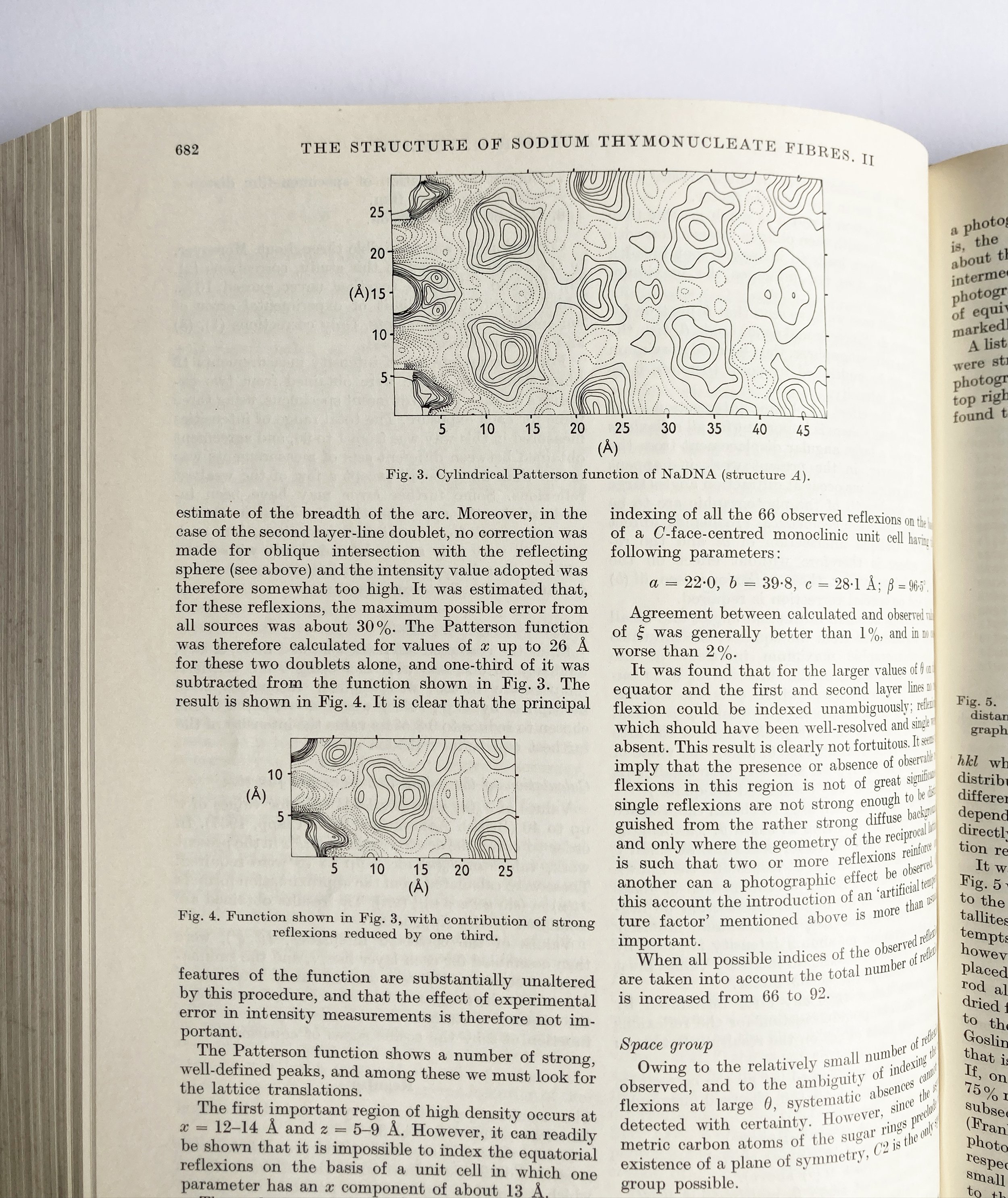
‘The structure of sodium thymonucleate fibres. I. The influence of water content [AND:] II. The cylindrically symmetrical Patterson function’
[IN:] Acta Crystallographica 6 (Copenhagen: Ejnar Munksgaard Ltd, 1953)
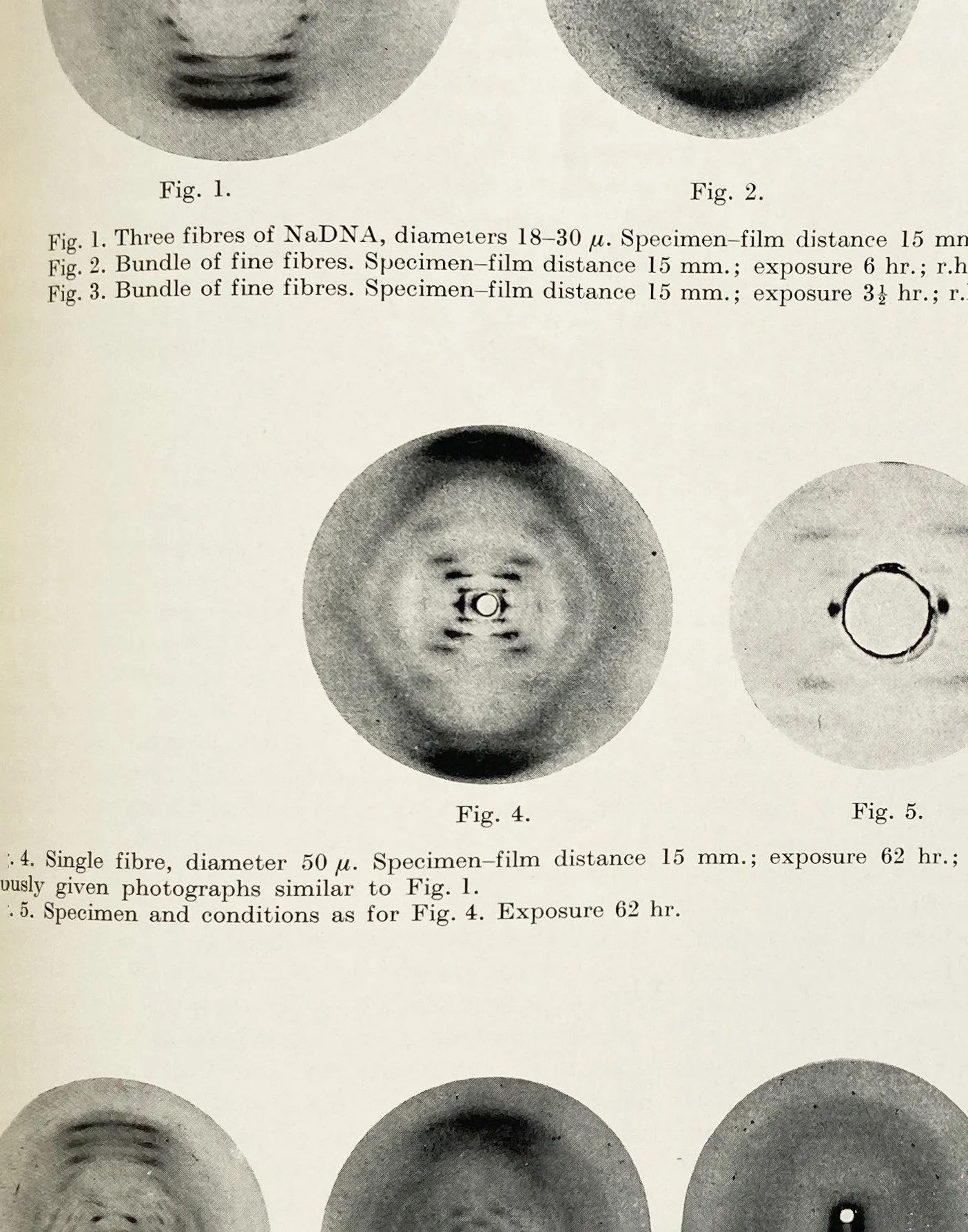
Cloth-bound large 8vo; pp. 888; Franklin and Gosling at pp. 673–684, with one plate
Rosalind Franklin’s major contribution to solving the structure of DNA, including the famous ‘Photo 51’, showing the helical structure of the B-form of DNA.
Franklin had arrived at King’s College London, to join the Biophysics group headed by J.T. Randall, in 1951, on a three year Turner & Newall Fellowship. Previously she had worked on the porosity of coal, and the X-ray crystallography of amorphous substances. At King’s Franklin took over (from Maurice Wilkins) the supervision of Raymond Gosling’s PhD, which was specifically concerned with the crystallography of DNA.
The pair used the very fine DNA samples prepared by Rudolf Signer, which had already contributed to Wilkins’ success in producing diffraction photographs. Franklin quickly discovered that DNA existed in two distinct forms, ‘A’ and ‘B’, depending on the hydration of the samples. ‘A’ produced more crystallographic data, while the higher-humidity ‘B’ gave images that were of less use in detailed structural analysis, but which clearly showed the helical structure of the molecule – though whether ‘A’ was also helical was a problem Franklin grappled with throughout 1952.
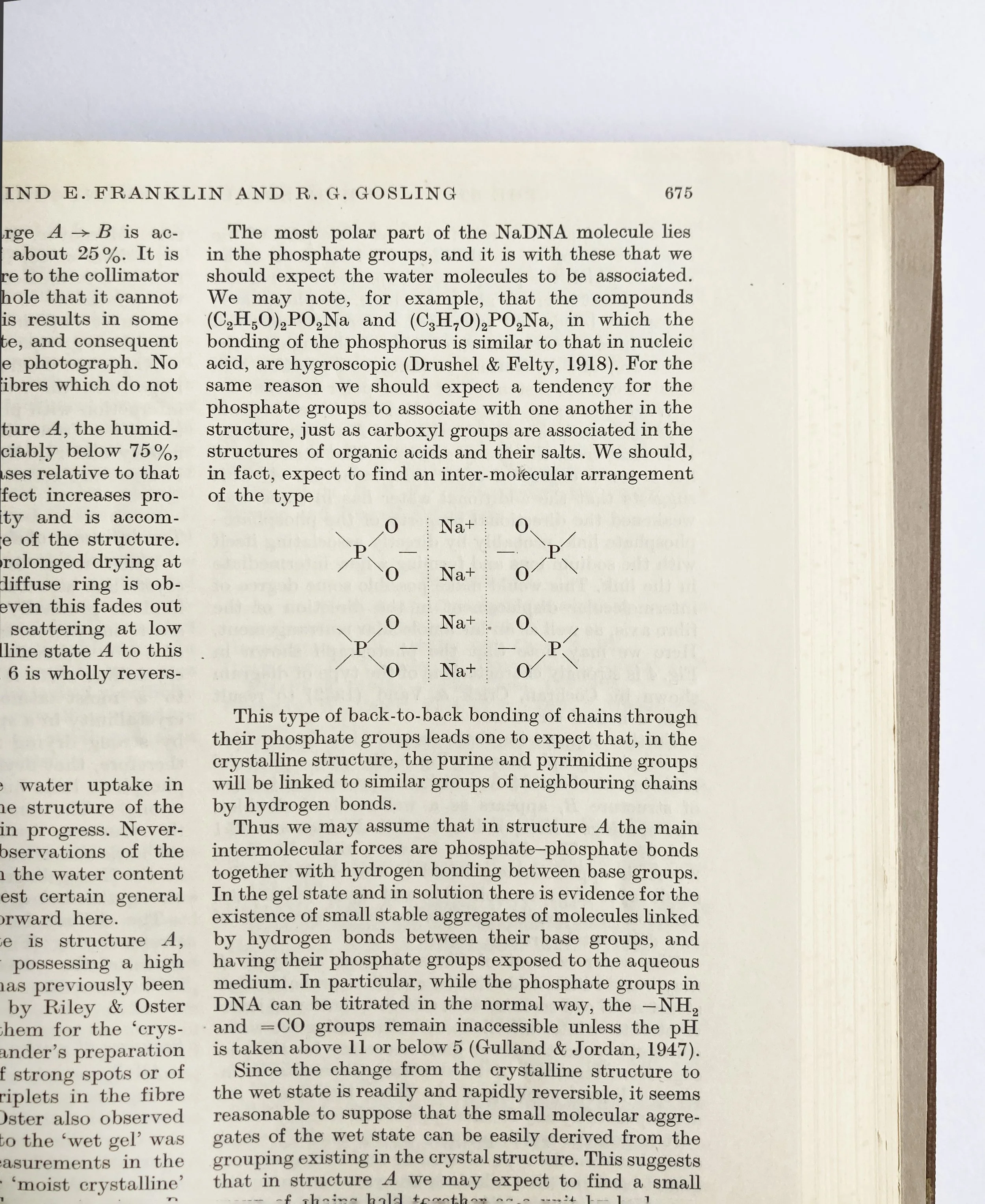
By the beginning of 1953 Franklin was becoming convinced of the helical structure of both ‘A’ and ‘B’, and indicated in her notebooks that she favoured a double-helical structure. Crucially, as described in these papers, she had also come to a firm conclusion about the placing of the phosphate chains in the molecule: these were to form an outer ‘skeleton’, with the nucleotides stacking in the middle. This ran counter to the ideas of both Watson and Crick at Cambridge, and Pauling and Corey at Caltech – though unbeknownst to Franklin, Watson and Crick were revising their thinking, not least in part owing to access they had gained to Franklin’s in-progress data.
Through the early months of 1953, Frankin and Gosling planned to publish using a dual strategy of a note in Nature, and a major paper (offered here) in Acta Crystallographica. These would announce and then present their data, and potentially pave the way for a final contribution, solving the structure itself. On March 6, the offices of Acta Crystallographica received Parts I and II of Franklin’s and Gosling’s major paper on the structure of DNA. Just one day later, Watson and Crick completed their model. Following this, Wilkins prepared a note on his own group’s work at King’s, and Franklin amended her and Gosling’s Nature note to become the third of the famous trio of April Nature papers announcing the structure of DNA. Although somewhat delayed by these developments, the Acta Crystallographica papers were published in September 1953 (a third part was published later, in 1955):
When Franklin saw the model, she had enough elements to understand that it was a reasonable model, because in the meantime she had arrived very near to the solution, as can be inferred from her notebooks and from two papers sent to press before Franklin knew of the Watson-Crick model. (Lindau Nobel Laureate website)
The first part describes the discovery of the B-form of DNA, and reproduces the famous ‘Photo 51’. Here Franklin and Gosling give a detailed account of the relationship of the phosphate chains and the nucleotides. Of the greatest interest is their statement that Photo 51 ‘is strongly characteristic of the type of diagram shown by Cochran, Crick & Vand (1952), to result from helical structure’. This, notably, is not one of the parts of paper ‘somewhat modified in the light of recent work’ – i.e. the 1953 Nature papers. The lie is therefore given to the notion that Franklin was either staunchly ‘anti-helical’ or that she had misunderstood the significance of the B-form photographs. The second part gives a detailed account of the Patterson analysis of the A-form of DNA. Here the crucial detail is the announcement that the A-form belongs to the space group C2. This was the information that convinced Crick of the double-helical structure of DNA – as it ruled out the triple-helix, and also confirmed that both the B- and A-forms could be helical. This second part also contains a direct assessment of the Watson/Crick model, in a ‘Note added in proof, 8 July 1953’, which accepts ‘the general features of the model’, while remaining guarded about accepting it ‘in detail’.
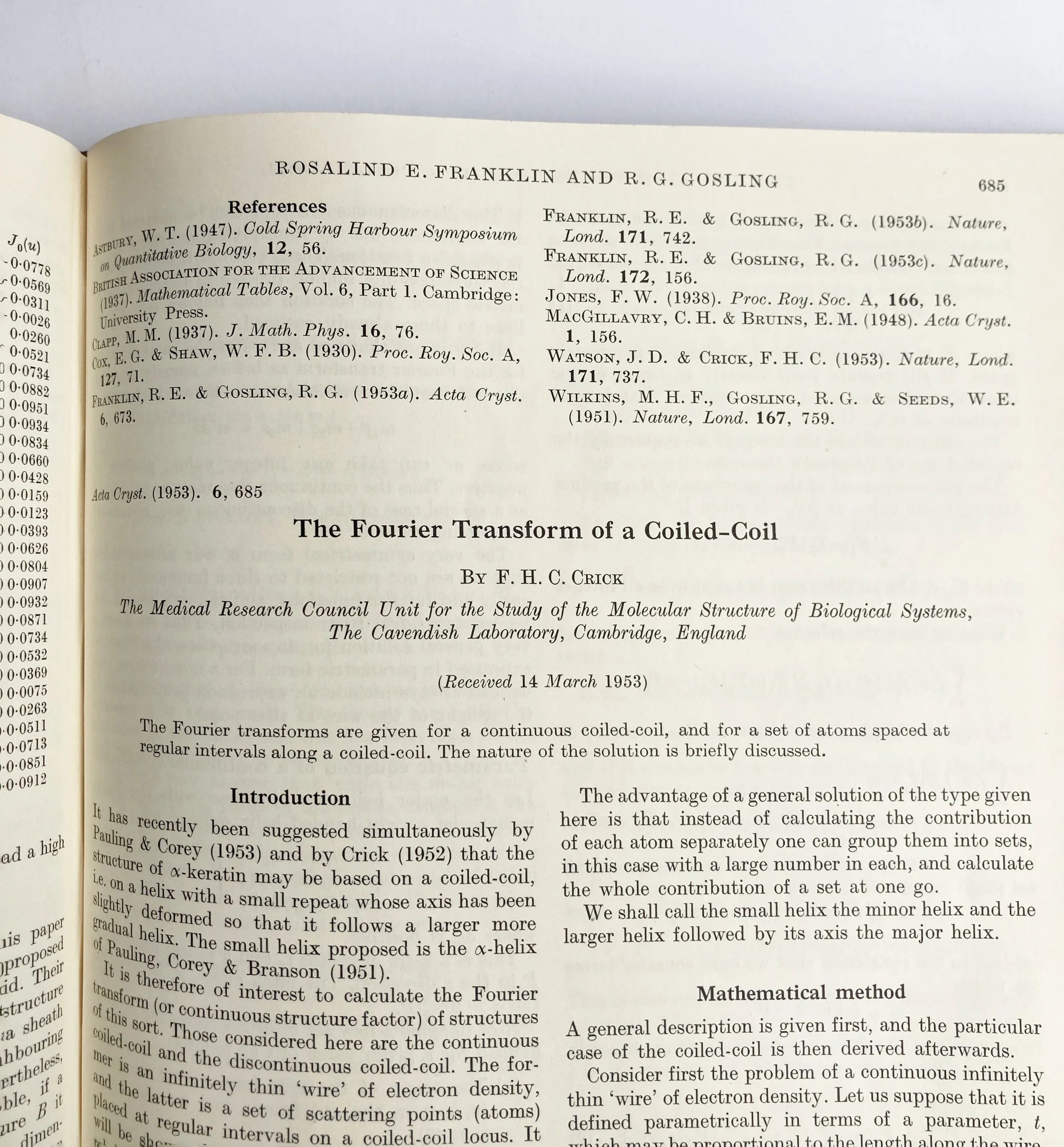
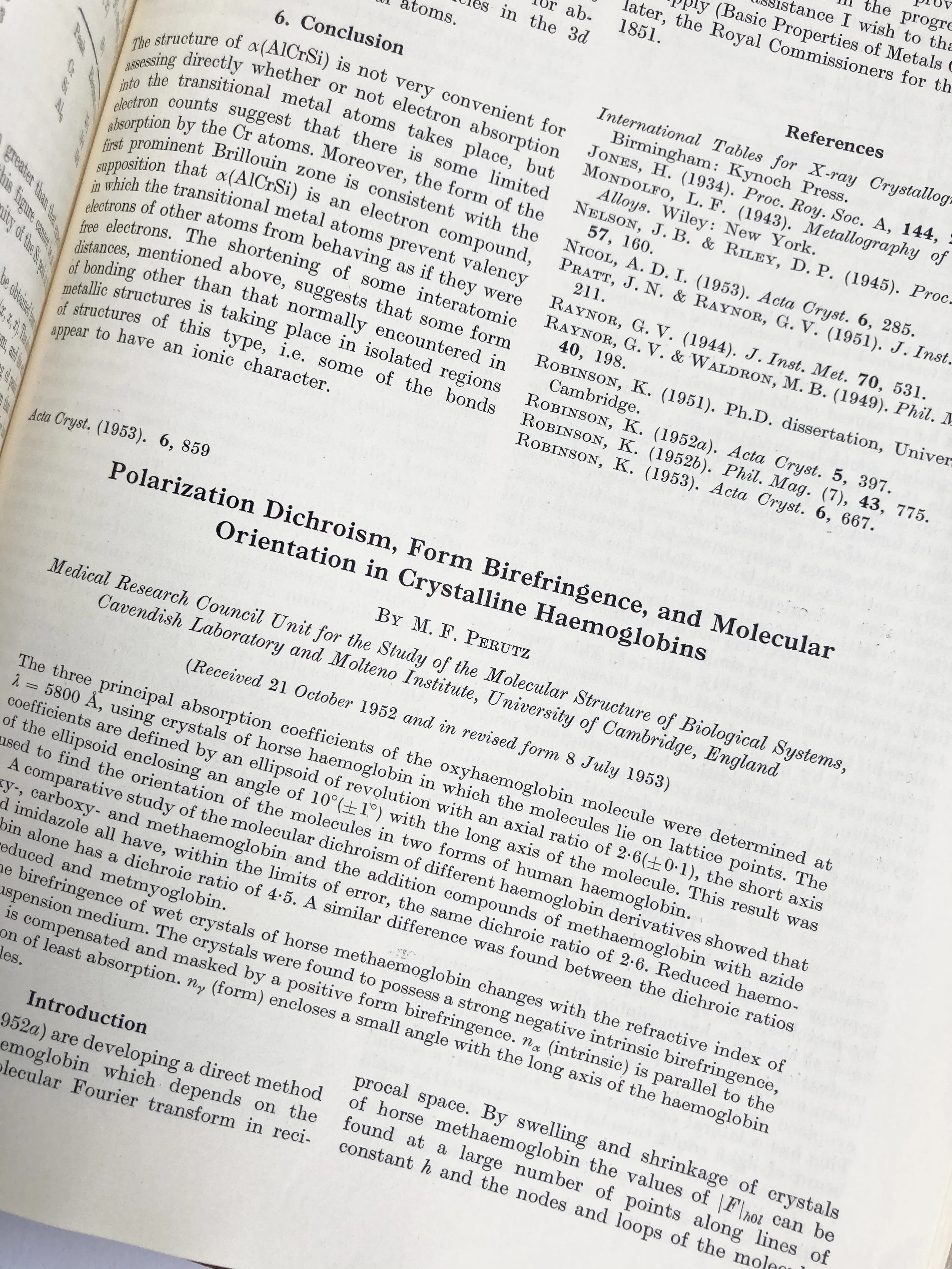
The volume contains many other important papers, in particular by Vittorio Luzzati, Crick, Max Perutz and Lawrence Bragg.
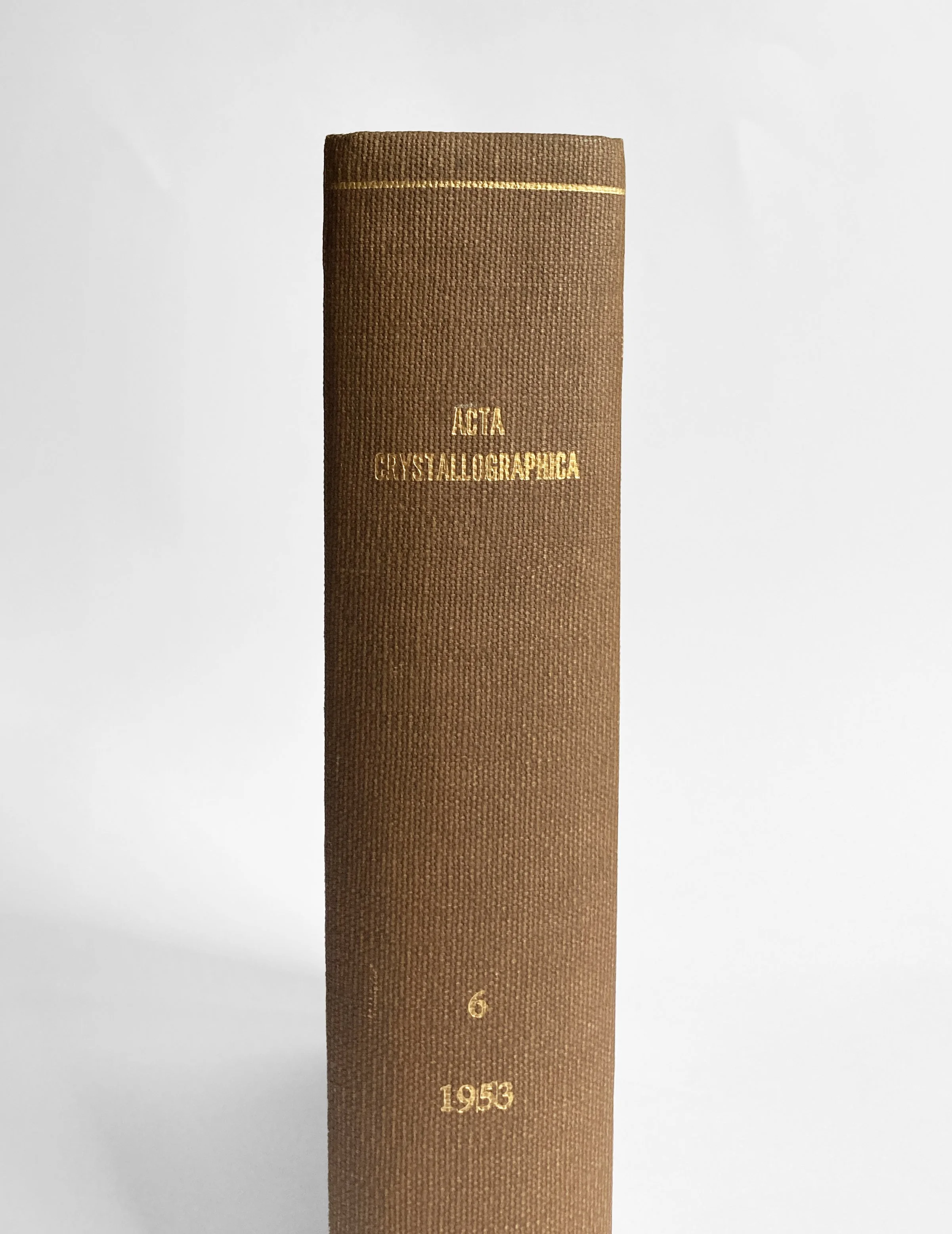
Very good condition: bound in plain brown buckram, with gilt-spine titles, though not ex library; internally clean and unmarked throughout.