

The earliest dated map measurer (opisometer), by James Wyld
The earliest dated map measurer (opisometer), by James Wyld
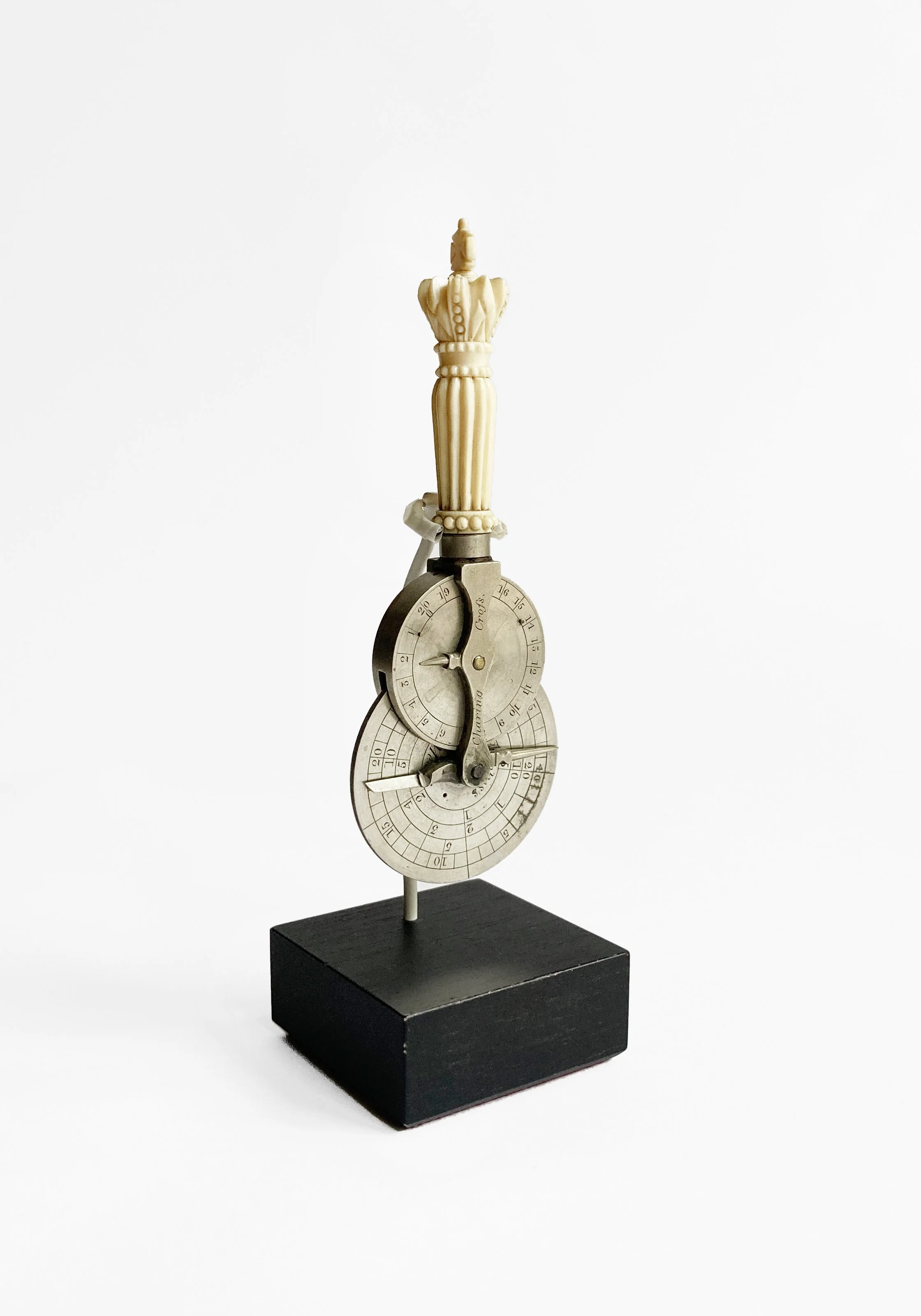
An important map measurer (opisometer)
Made by James Wyld (1812–1887), to the design of William Brookes (1817–1884), both of Chancery Lane, London, circa 1845
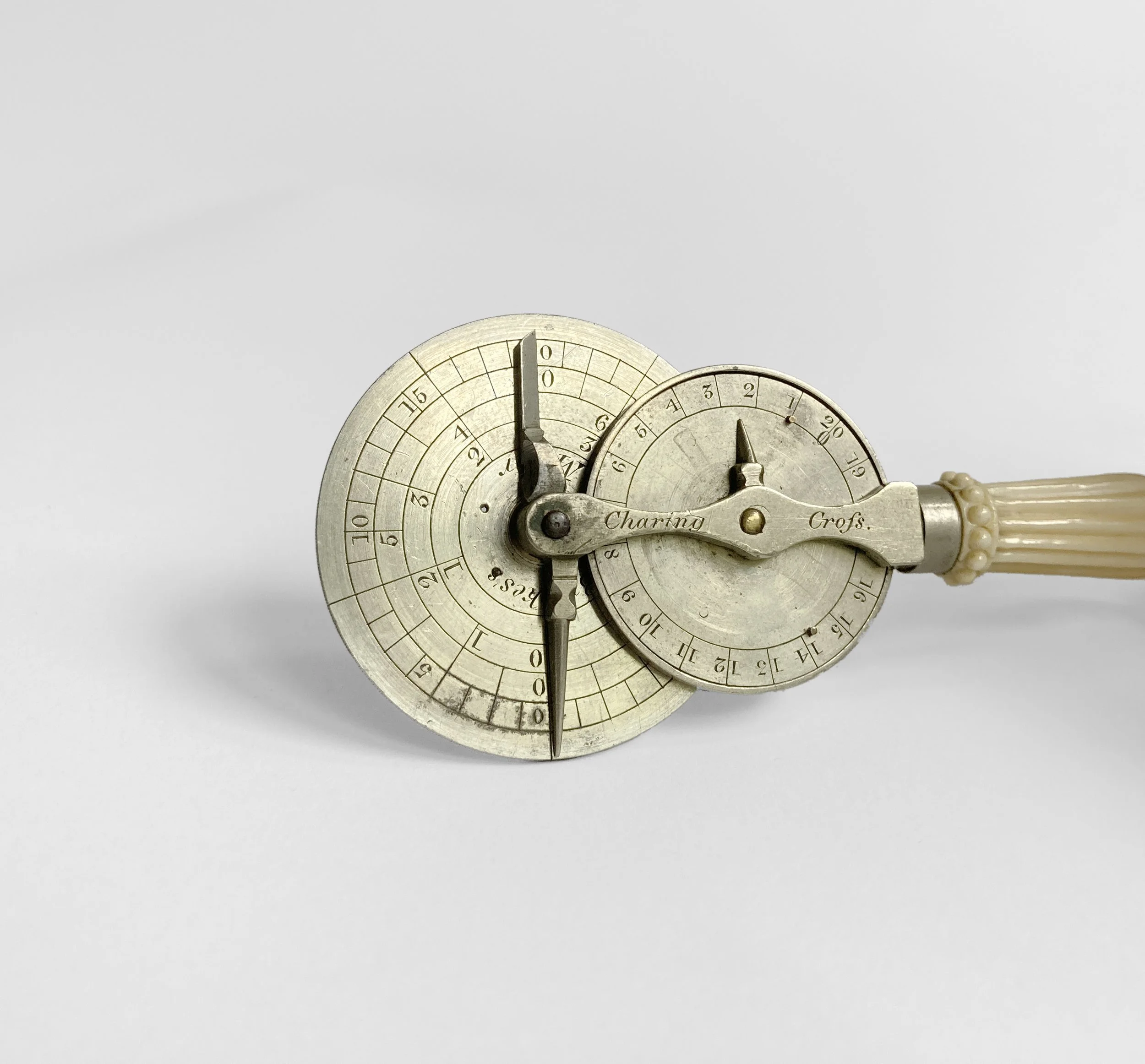
Two geared metal discs with index arms; ivory handle with crown finial, 108mm tall
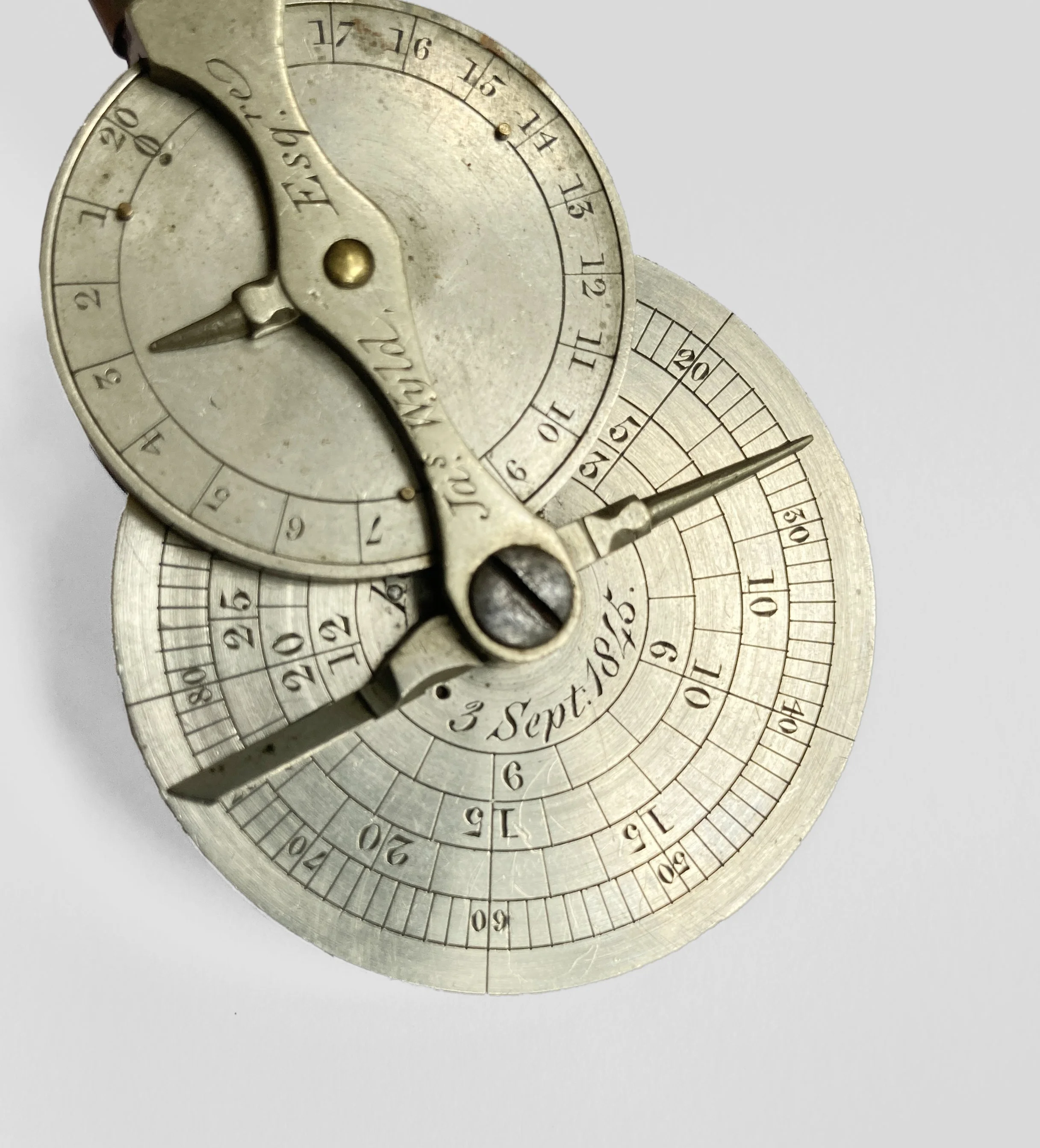
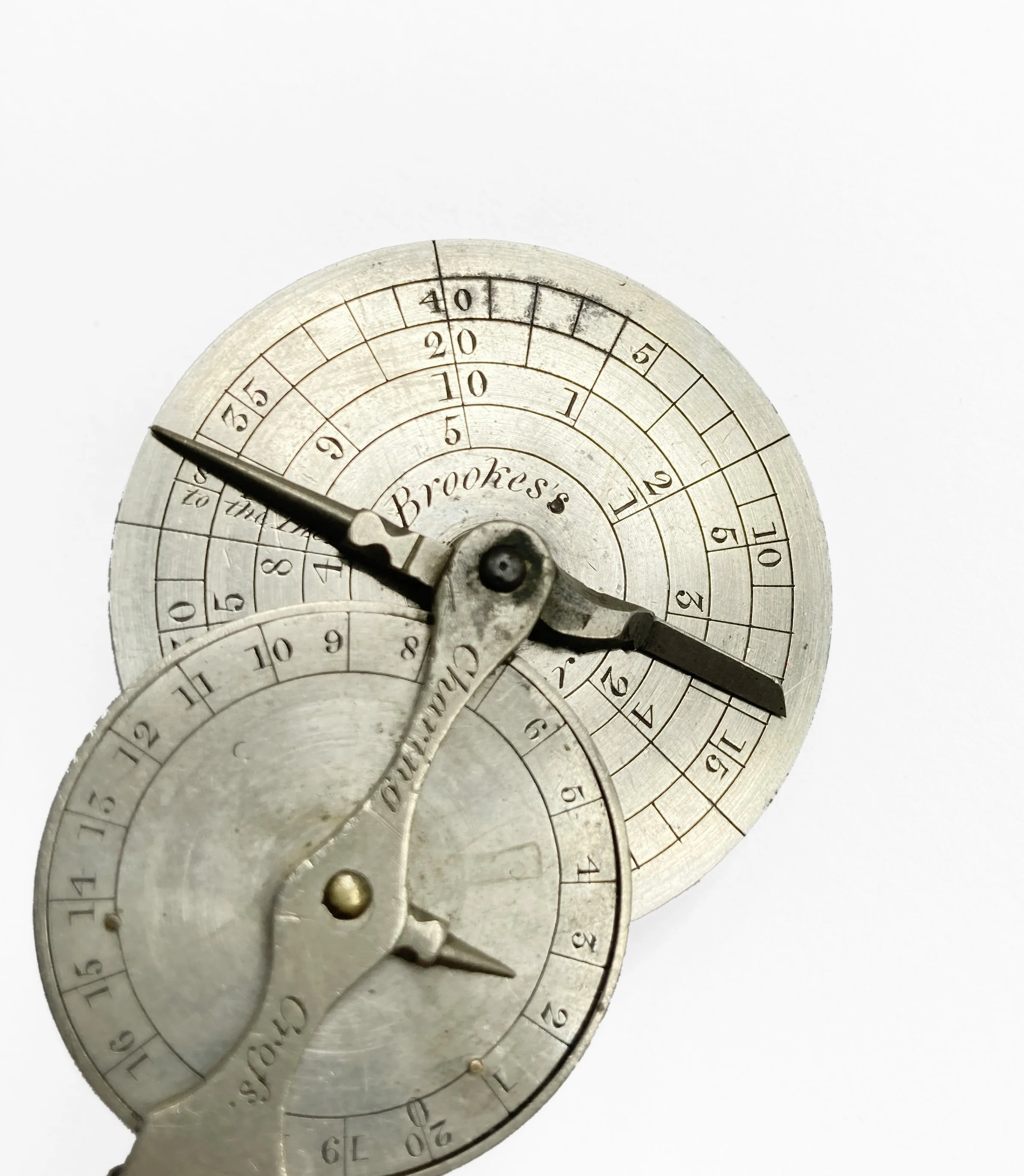
The earliest dated automatic map-measurer, and the only known instrument by renowned and royally appointed cartographer James Wyld. This extraordinarily elegant little instrument bears three inscriptions: ‘Brookes's Meter’; ‘Registered 3 Sept. 1845’; and ‘Jas Wyld Esq.re Charing Cross’. Each of these bears scrutiny.
We are confident in attributing the design to Wyld’s neighbour William Brookes, a patent agent, consulting engineer and inventor who specialised in the weaving, lace, and knitting industries. Remarkably, a descendent of Brookes’ IP firm is active to this day. Amongst his other inventions were: ‘improvements in means or apparatus for the manufacture of illuminating gas from petroleum’; ‘improvements in treating fabrics suitable for floor cloths’; and ‘improvements in the manufacture of boxes’.
The year of the patent, 1845, is also significant, as this must be one of the earliest automatic map measurers. A traditional technique for measuring irregular lines involved the use of a roller and thread to measurer distances on maps and surveys. In 1851 the instrument makers Elliott and Son brought out an instrument they called an ‘opisometer’ (thus coining the word), which consisted of a milled wheel that moved along an axial screw as it turned, thus making the measurement replicable against a scale. But the present instrument is an entirely different and far more sophisticated design, in which the instrument, held horizontally, automatically records revolutions on a set of divided scales (for different map scales), with this in turn geared to an index wheel numbered 0–20. An similar early instrument at the Science Museum is signed ‘Frodsham’, but is undated (inv. no. 1979-265).
The fact that this instrument was made by James Wyld is perhaps even more surprising. Wyld was the son of a successful map-maker (James Wyld Snr), inherited a thriving business, became a fellow of the Royal Geographical Society in 1839, and was appointed Geographer to Queen Victoria and Prince Albert. However, he is not known as an instrument maker, and in fact this is the sole known instrument bearing his signature, a fact perhaps explained by the proximity of Wyld and Brookes. We could conjecture, for example, either that Brookes desired a sample of his invention to be made – or that Wyld heard of the invention and wanted one for himself. A third possibility is that the instrument was made for a prestigious client, or for exhibition. Note, in this connection, the beautifully crafted royal finial to the handle.
In spite of its humble appearance, the opisometer is one of the most useful of all analogue computers, allowing complex lines (rivers, roads, boundaries and borders, and even abstract shapes) to be calculated quickly and easily. In fact the opisometer in principle negates an enormous computational problem, and the fact that it does so automatically marks a step change from previous comparative techniques, such as laying string on the map, or using a more rudimentary device like the Elliott and Son opisometer mentioned above. In turn, the invention of the opisometer added hugely to the utility of maps and surveys themselves as sources of data.
By the late-19th century Wyld’s approach was generally accepted: the simple Elliott and Son design was augmented with a linear scale, and many other geared instruments with dials were developed by companies such as W.F. Stanley, Faber-Castell, S.J. Hawkins, and Philips.
Very good condition: ivory handle somewhat yellowed, with a very slight hair crack (but fully intact and firm); very light wear to the two wheels, but see photographs.
Note that this item contains ivory, and has been granted an exemption under the Ivory Act (2018), on the grounds of ‘outstandingly high artistic, cultural or historical value’. The certificate number is NGHV4A9R. This certificate is transferable upon purchase and permits legal sale within the United Kingdom only.