

'THE WU EXPERIMENT'
'THE WU EXPERIMENT'
WU, Chien-Shiung (1912–1997), et al.
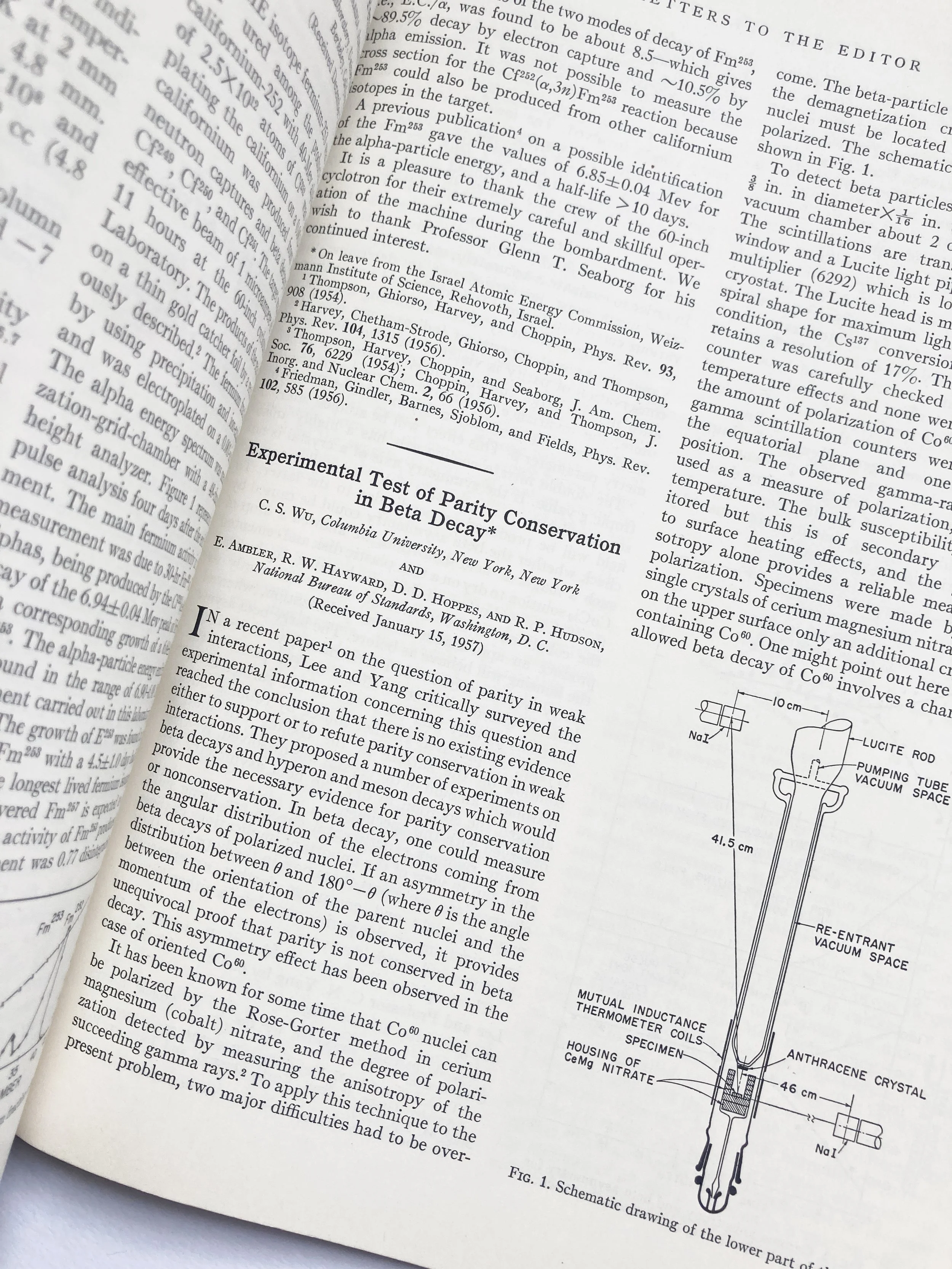
‘Experimental Test of Parity Conservation in Beta Decay’
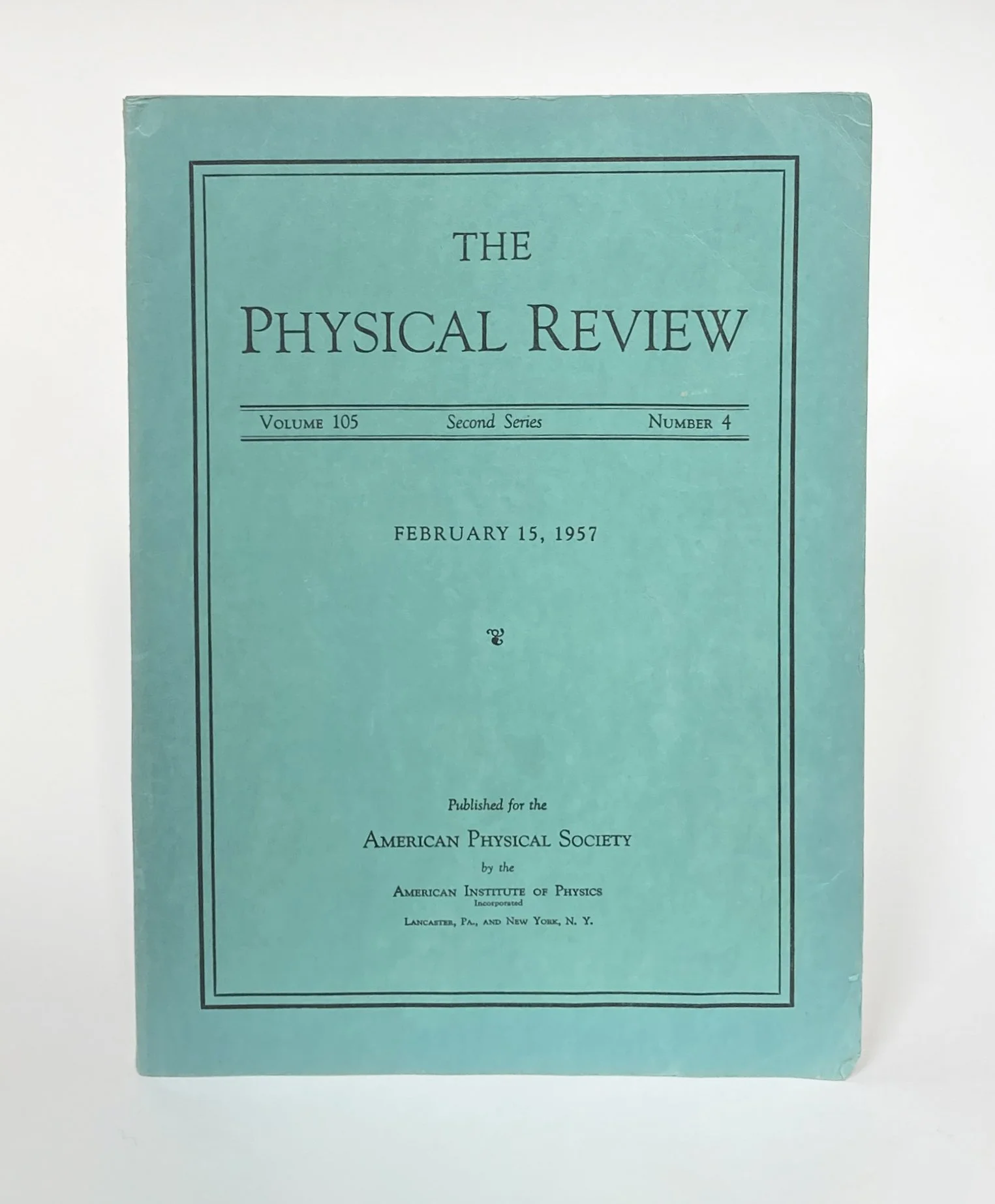
[in:] Physical Review, Vol. 105, No. 4
Lancaster PA and New York NY: American Institute of Physics, 15 February 1957
Octavo (267 x 201mm); pp. 245–508, Wu et al. at pp. 491–505
Single issue in original wraps; near fine condition
One of the most important experiments in the history of science. The Wu Parity Experiment, conducted in 1956 by physicist Chien-Shiung Wu and her collaborators, fundamentally changed our understanding of the laws of physics. At the time, it was widely believed that the laws of nature were symmetrical under spatial inversion – a concept known as parity conservation. This assumption implied that the laws governing physical processes should remain unchanged if all spatial coordinates were flipped, like viewing the process in a mirror. However, theoretical work by Tsung-Dao Lee and Chen-Ning Yang questioned this assumption for weak nuclear interactions, suggesting parity might not be conserved in such cases.
To test this, Wu designed a meticulous experiment using the beta decay of cobalt-60 atoms at extremely low temperatures and in the presence of a strong magnetic field to align their nuclear spins. Her team observed that the emitted electrons were preferentially emitted in a direction opposite to the nuclear spin – a clear violation of mirror symmetry. This provided direct, experimental evidence that parity is not conserved in weak interactions, overturning a long-standing principle in physics. The results were so profound that they shook the foundations of quantum mechanics and required revisions to theoretical models of particle interactions.
Chien-Shiung Wu was a trailblazing physicist whose contributions to nuclear and particle physics not only advanced science but also broke significant gender and cultural barriers in the scientific community. Often referred to as the ‘First Lady of Physics’, Wu’s precision, rigour, and ingenuity in experimental design earned her a reputation as one of the most accomplished experimental physicists of the 20th century. Her neglect by the Nobel Prize committee is considered one of the greatest injustices in the history of the prize. In 1978 Wu was awarded the inaugural Wolf Prize, finally granting her recognition for this extraordinary experimental breakthrough.
References: The Biographical Dictionary of Women in Science, Vol. 2, pp. 1409–1410; Jiang, Madame Wu Chien-Shiung: The First Lady of Physics Research (2013)