

Cantor's 'Continuum Hypothesis' (1877)
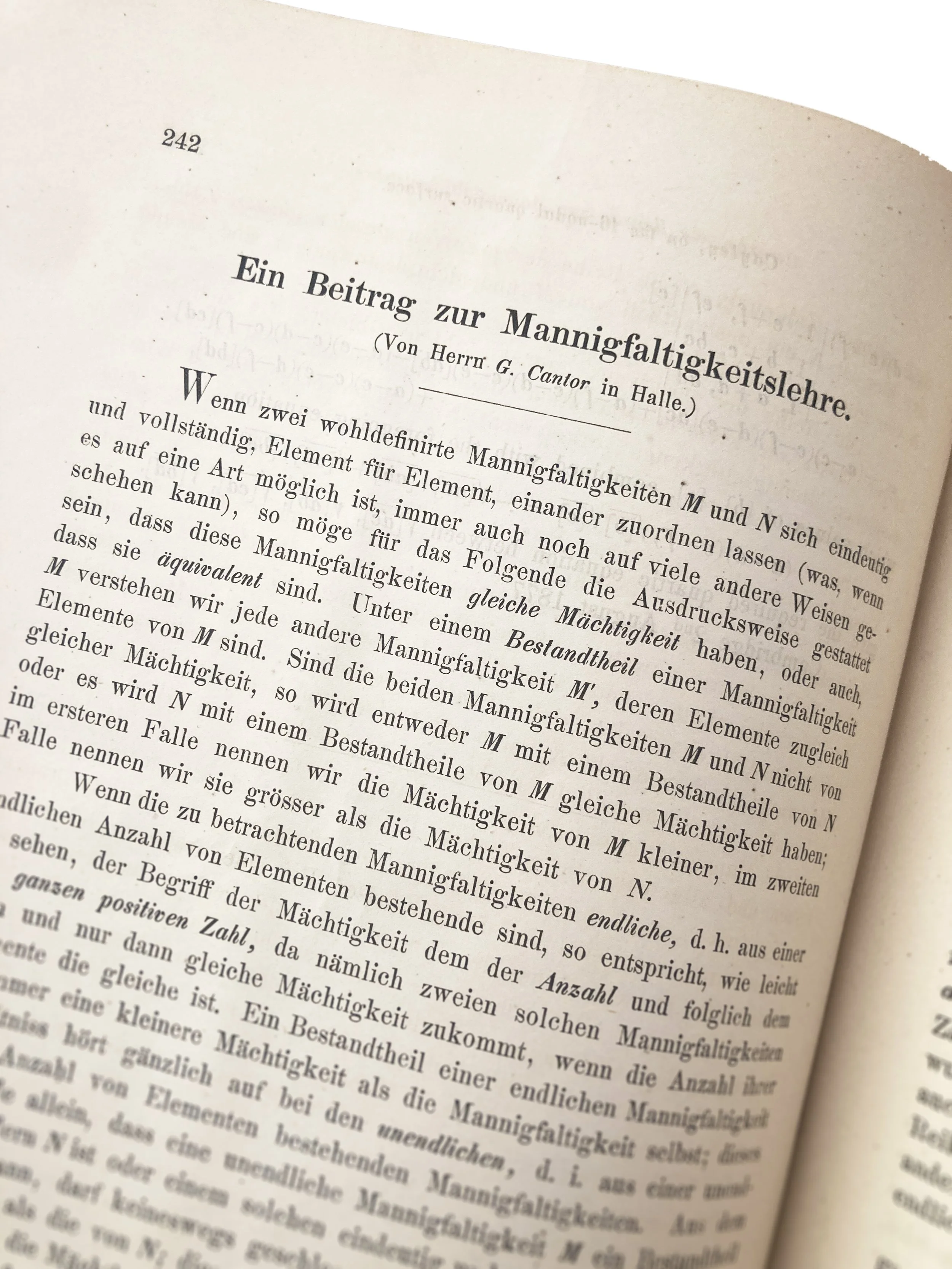
Cantor's 'Continuum Hypothesis' (1877)
CANTOR, Georg (1845–1918)
‘Ein Beitrag zur Mannigfaltigkeitslehre’
[in:] Journal für die reine und angewandte Mathematik, Vol. 84
Berlin: G. Reimer, 1877
Quarto (280 x 220mm); pp. iv, 359 (Cantor at pp. 242–258)
Whole volume in contemporary cloth binding; minimal ex-library markings. Very good condition faint foxing to prelims but otherwise very good internally
Essay
The first publication of ‘the Continuum Hypothesis’, one of the most profound statements about the nature of infinity, and a foundational work in Set Theory.
The Hypothesis states that: There is no set whose cardinality is strictly between that of the integers and the real numbers.
With this idea Cantor was attempting to resolve a fundamental question about the new kinds of infinity that his revolutionary Set Theory generated. The integers make up what we might call an intuitive infinity; Cantor, with his diagonal argument, had shown that the infinite set of real numbers was bigger than that of the integers – so how were these two orders of infinity related? The Continuum Hypothesis suggests that the two orders are contiguous, that another order of infinity cannot be interpolated between them.
David Hilbert was so impressed with this idea that he made its proof or disproof the first of his famous 23 problems in 1900. A few decades later Gödel showed that the Continuum Hypothesis was consistent with the axioms of Set Theory, i.e. it could not be disproved with the mathematical tools then available. But, astonishingly, Paul Cohen later showed that the Continuum Hypothesis could not be proved either – work that won him the Fields Medal in 1966. So the Continuum Hypothesis lies outside of the known world of mathematics.
At the deepest level the Continuum Hypothesis poses a question about the nature of mathematical reasoning itself: can there be a problem to which there simply is no answer? Cohen believed so: the Continuum Hypothesis is unanswerable, so one could assume it was true or untrue and each would lead to a rigorous though independent mathematics. Gödel, meanwhile, believed that the failure to resolve the Continuum Hypothesis just showed the paucity of the methods employed. Research into the Continuum Hypothesis continues to this day, and has resulted in many breakthroughs in Set Theory in the last century and a half.
References:
Grattan-Guiness, From the Calculus to Set Theory, pp. 197ff.