

Mendel's laws of inheritance analyzed in 1872
Mendel's laws of inheritance analyzed in 1872
BLOMBERG, Albert (1844–1922)
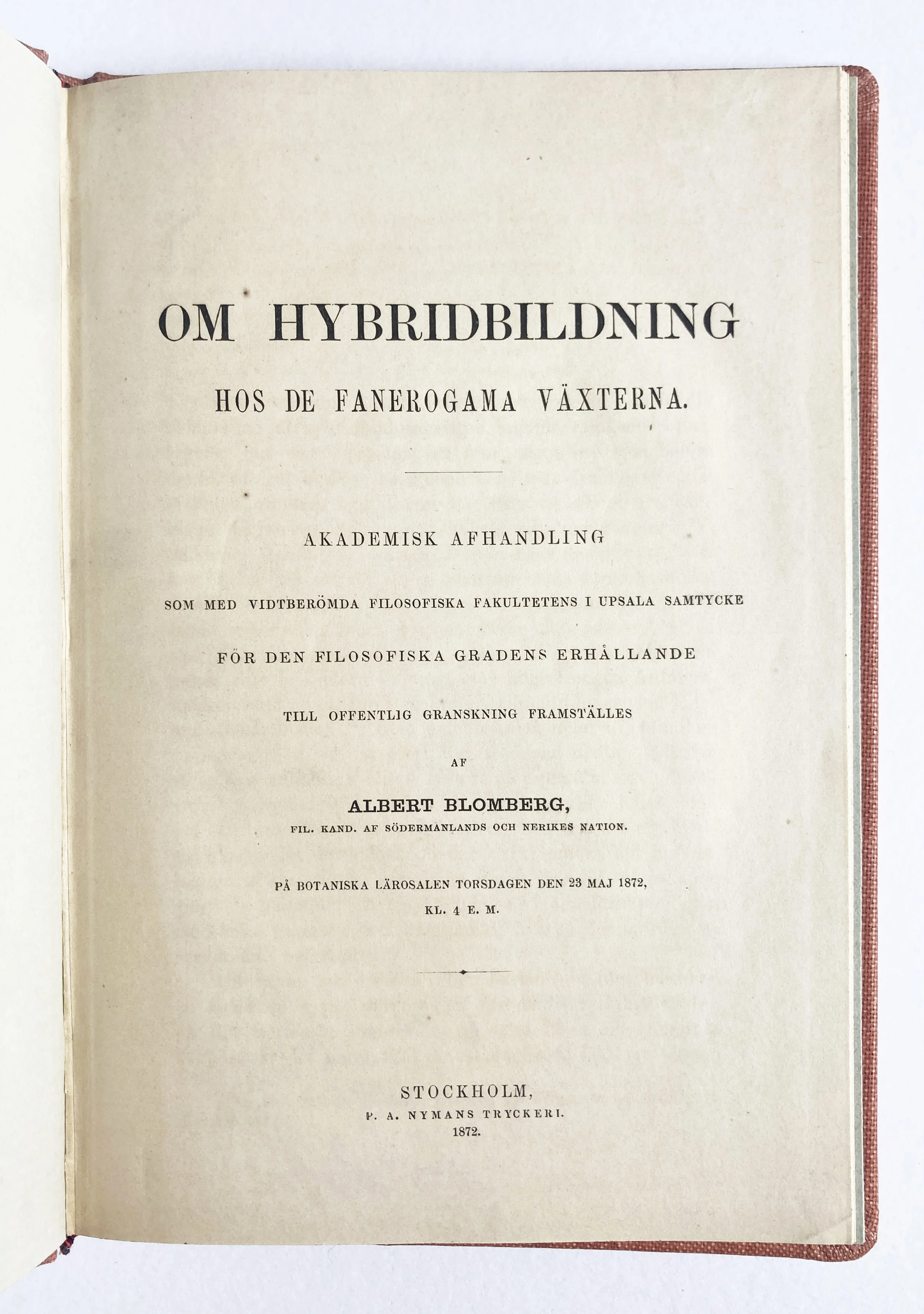
Om hybridbildning hos de fanerogama växterna
Stockholm: P. A. Nymans Tryckeri, 1872
Octavo (240 x 139mm); pp. 41
Academic thesis issued in self-wraps; bound with another shorter work on botany in later brick-red cloth with gilt title to the spine; ownership signature to the front free endpaper
Essay
The earliest recorded discussion of Gregor Mendel’s Laws of Inheritance. In 1865 Mendel had published his famous paper ‘Versuche über Pflanzen-Hybriden’, describing his experiments with pea plants (mostly Pisum sativum), in which he showed that traits are inherited as discrete units, and established the famous 1:2:1 ratio of variation. The standard account is that these results were entirely forgotten until 1900, when a group of papers constituted the ‘rediscovery’ of Mendel and the true origin of Mendelianism.
Extensive bibliographic research has revealed a more complicated situation: in 1869 Hermann Hoffmann referred briefly to Mendel, but did not discuss his Laws of Inheritance, merely mentioning the work and reporting briefly on the results. Then in 1872 the present work appeared, a dissertation by a little known Uppsala student botanist Albert Blomberg, the title of which translates as On Hybrid Formation in Phanerogamous Species. Blomberg’s thesis is really a literature review of recent work on hybridization, and he cites Mendel a number of times, writing on page 37 that
Mendel supposes that two kinds of characters are transmitted to the hybrid when it is formed: ‘dominant’ are those which in the first generation determine the appearance of the hybrid, and ‘recessive’ those which in the beginning are latent.
In addition to this specific reference to Mendel’s breakthrough discovery, Blomberg also gives a careful account of Mendel’s thinking on the constancy of hybrids. That Mendel would be known in Uppsala is perhaps explained by the presence there of the mycologist Elias Fries, who was an expert on Hieracium – the other main genus studies by Mendel after Pisum.
As a student thesis this text is predictably rare – in fact the reference to Mendel was only noticed in 1915. Two copies can be located in the uk, at Kew and the Natural History Museum. Only one copy can be located outside Europe, at the Center for Research Libraries, Chicago IL.
Provenance:
Arne H. Holmqvist (20th-century Swedish botanist)
References:
Orel, ‘The enigma of hybrid constancy in Mendel’s Pisum paper perceived by Albert Blomberg in 1872’